

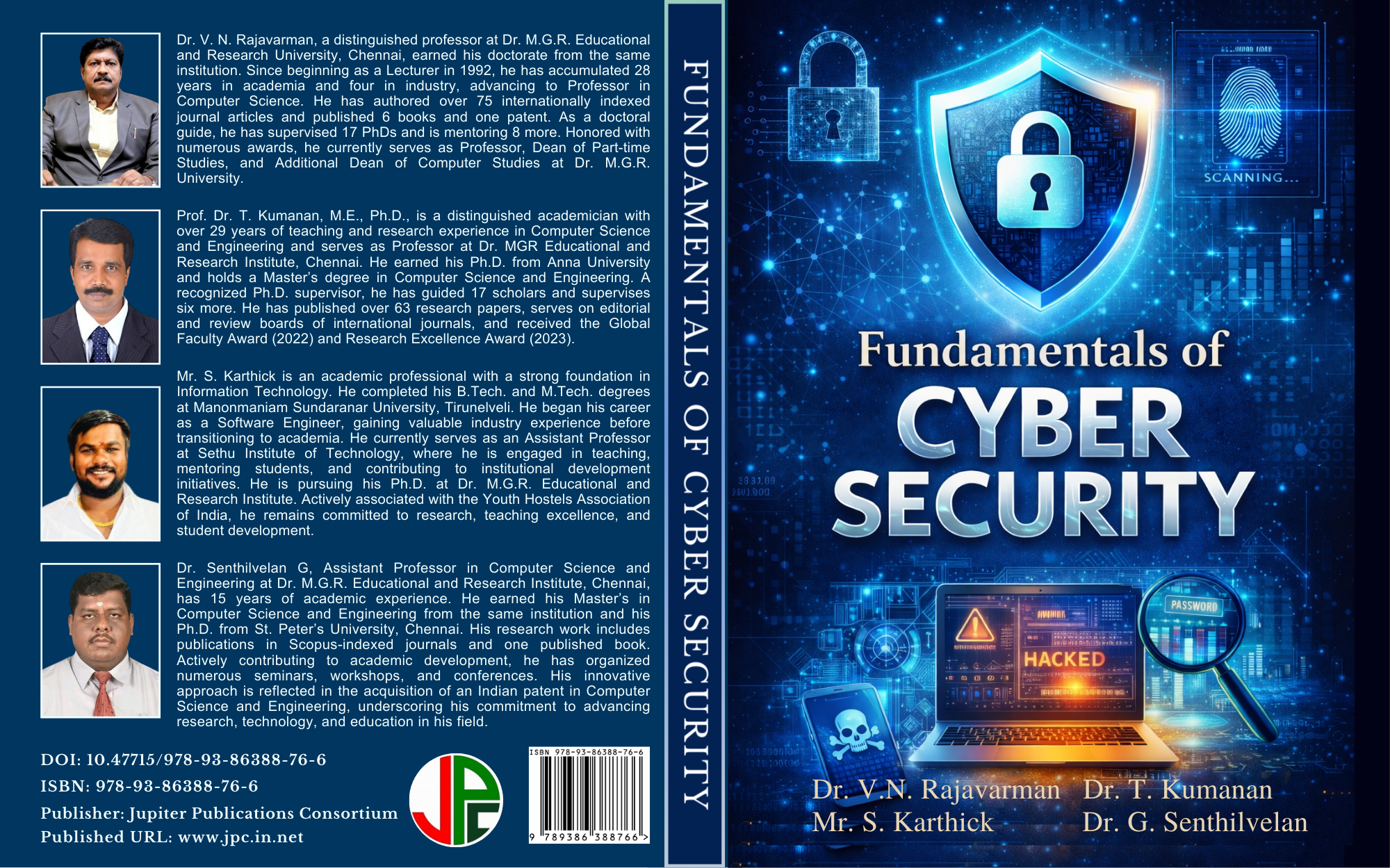
Fundamentals of Cyber Security
Build Practical Cybersecurity Thinking for the Modern Digital World
Fundamentals of Cyber Security is a structured, academic, and application-oriented book that introduces cybersecurity as a discipline of protecting digital assets, managing risk, and applying responsible security practice. Rather than presenting cybersecurity as a collection of isolated technical attacks, the book explains it as a systematic field built on concepts, controls, verification, monitoring, and ethical decision-making.
Authored by Dr. V. N. Rajavarman, Dr. T. Kumanan, Mr. S. Karthick, and Dr. G. Senthilvelan, this book is published by Jupiter Publications Consortium, Chennai, India. It is released as the First Edition, February 2026, with ISBN 978-93-86388-76-6, DOI www.doi.org/10.47715/978-93-86388-76-6, and MRP INR 450/-.
About the Book
In today’s interconnected world, cybersecurity has become an essential foundation for education, business, governance, communication, and digital infrastructure. Fundamentals of Cyber Security is designed to help learners understand the principles, practices, and structures that support modern cyber defense. The book presents cybersecurity as a field concerned not only with threats and attacks, but also with asset protection, risk assessment, policy, architecture, monitoring, and incident response.
The book follows a practical academic progression. It begins with foundational terminology and core principles, then moves into threat landscapes, security models, governance, endpoint and operating system security, authentication, malware, network defense, cloud and container security, cryptography, application security, data protection, testing, monitoring, and incident response. This makes it a strong introductory text for learners who need both conceptual clarity and broad technical coverage.
Abstract
Fundamentals of Cyber Security introduces cybersecurity as a structured discipline centered on protecting assets and managing risk. The book develops the learner’s understanding from foundational terminology and security goals to threat landscapes, defensive controls, endpoint protection, identity and access management, malware, virtualization, cloud and container basics, network security, cryptography, web and application security, data protection, security testing, reporting, monitoring, and incident response. Emphasizing conceptual clarity, ethical practice, and defensible control selection, the book provides a comprehensive academic foundation for students, instructors, self-learners, and emerging cybersecurity professionals.
Keywords
Cyber security, asset protection, threat landscape, vulnerability, risk management, CIA triad, security controls, governance, endpoint security, authentication, access control, malware, cloud security, container security, network defense, cryptography, web security, application security, data protection, security testing, monitoring, SIEM, SOC, incident response, continuity planning
Why This Book Matters
Cybersecurity failures today can lead to operational disruption, financial loss, privacy breaches, reputational damage, regulatory issues, and even public safety concerns. This book helps learners move beyond memorizing terms and instead develop the ability to think systematically about what must be protected, why it matters, how it can be attacked, and which controls can reduce risk.
The book emphasizes:
- foundational security thinking
- layered defense strategies
- ethical and authorized practice
- governance and compliance awareness
- technical and conceptual integration
- monitoring and incident readiness
- continuity and recovery planning
Who this book is for
This book is especially suitable for:
- B.Tech, M.Tech, and MCA students
- faculty and academic instructors
- beginners in cybersecurity
- self-learners building foundational knowledge
- entry-level professionals seeking a structured introduction
- learners interested in security operations, governance, or defensive practice
It assumes a basic background in computing, such as familiarity with operating systems, programming, or networking fundamentals, but does not require prior cybersecurity specialization.
What Readers Will Learn
The book offers structured exposure to major domains of cybersecurity through a comprehensive academic approach.
Cyber Security Foundations and Overview
Readers are introduced to the meaning, scope, and importance of cybersecurity. The book explains the language of assets, threats, vulnerabilities, risks, and controls, along with the CIA triad and the major domains of cybersecurity.
Threat Landscape and Attack Lifecycle
The text discusses threat actors, motivations, attack surfaces, stages of attack, kill chain concepts, and modern threat frameworks. It helps learners understand how attacks develop and how defenders interpret indicators and behavior.
Security Principles and Models
The book explains important principles such as least privilege, defense in depth, secure defaults, trust boundaries, and conceptual security models. These ideas form the basis of secure design and security architecture.
Risk Management and Governance Basics
Readers learn about likelihood, impact, risk assessment, policy hierarchy, awareness, compliance, and ethics. This section establishes cybersecurity as both a technical and governance discipline.
Operating System and Endpoint Security
The book covers user accounts, groups, permissions, secure configurations, hardening, patching, endpoint protection, and backup readiness. These topics help learners understand how operating systems and devices are secured.
Authentication and Access Control
This section explains authentication versus authorization, password security, multi-factor authentication, sessions, tokens, single sign-on, privilege escalation concepts, and identity and access management fundamentals.
Malware and System Exploitation Basics
The text introduces malware families, infection vectors, persistence, evasion, exploit concepts, payloads, ransomware, and safe handling practices. It helps learners understand the defensive perspective on malicious software.
Virtualization, Containers, and Cloud Security Basics
Readers are introduced to virtual machines, containers, shared responsibility, container registry risks, identity, and secrets in cloud environments. This section connects cybersecurity to modern infrastructure.
Network Security Fundamentals
The book explains firewalls, NAT, proxies, segmentation, DMZ, VPN, IDS, IPS, and layered network protection concepts that are central to modern enterprise defense.
Network Attacks and Defenses
This section covers spoofing, man-in-the-middle attacks, denial-of-service concepts, wireless security issues, and common defensive responses to network-based threats.
Cryptography Essentials for Cyber Security
The book introduces symmetric and asymmetric encryption, hashing, digital signatures, certificates, PKI, TLS, HTTPS, and key management concerns. This gives readers a practical foundation in cryptographic trust.
Web and Application Security Fundamentals
Readers learn about web architecture, authentication weaknesses, SQL injection concepts, cross-site scripting, CSRF, insecure dependencies, and secure coding practices.
Data and Database Security
The text addresses classification, access control, encryption, DLP, privacy, and protection of structured and unstructured data in organizational systems.
Security Testing and Reporting Basics
This section explains scanning, assessment, penetration testing boundaries, threat modeling, validation, severity rating, and professional reporting practices.
Logging, Monitoring, and SOC Basics
The book introduces the role of logs, common log sources, event correlation, SIEM concepts, triage, false positives, and the basic workflow of security operations.
Incident Response and Continuity
The final sections discuss incident phases, containment, evidence handling, recovery, lessons learned, continuity planning, resilience, and communication during security events.
Key Strengths of the Book
Comprehensive Coverage
The book spans foundational concepts, technical defense areas, monitoring, testing, and response, making it a complete introductory cybersecurity textbook.
Academic Structure
Its chapter-by-chapter progression supports classroom teaching, self-study, and curriculum-based learning.
Practical Security Reasoning
The book repeatedly encourages learners to connect assets, threats, vulnerabilities, controls, and verification, which reflects real-world defensive thinking.
Responsible and Ethical Framing
It emphasizes that testing, scanning, credential analysis, and other security activities must be performed only with authorization, within ethical and professional boundaries.
Readiness for Modern Cybersecurity
By including cloud, containers, IAM, SOC concepts, and incident response, the book reflects the broader realities of present-day cybersecurity practice.
Learning Experience
The book is designed to support multiple learning paths. It works well as a university textbook, a guided self-learning resource, and a foundational reference for learners preparing for early-stage cybersecurity roles. Its structure encourages readers to move from definitions and models to examples, and from examples to control selection and validation.
This teaching approach helps students build analytical discipline rather than simply memorizing terminology. It supports the development of cybersecurity thinking that can be applied in academic, technical, and organizational settings.
Authors
- Dr. V. N. Rajavarman
- Dr. T. Kumanan
- Mr. S. Karthick
- Dr. G. Senthilvelan
Book Details
Title: Fundamentals of Cyber Security
Authors: Dr. V. N. Rajavarman, Dr. T. Kumanan, Mr. S. Karthick, Dr. G. Senthilvelan
Publisher: Jupiter Publications Consortium
Edition: First Edition
Published: February 2026
ISBN: 978-93-86388-76-6
DOI: www.doi.org/10.47715/978-93-86388-76-6
MRP: INR 450/-
Printed in: India
Publisher Address
Jupiter Publications Consortium
22/102, Second Street, Venkatesa Nagar,
Virugambakkam, Chennai 600 092,
Tamil Nadu, India
Remarks
Whether used in the classroom, for self-study, or as a foundational guide for emerging professionals, Fundamentals of Cyber Security offers a comprehensive and disciplined pathway into cybersecurity. By connecting principles, threats, controls, governance, monitoring, and response, the book helps readers understand not only what cybersecurity is, but how it is reasoned, applied, and practiced in the modern digital world.
How to cite:
Rajavarman, V. N., Kumanan, T., Karthick, S., & Senthilvelan, G. (2026). Fundamentals of Cyber Security (1st ed.). Jupiter Publications Consortium. DOI: 10.47715/978-93-86388-76-6
APA 7th
Rajavarman, V. N., Kumanan, T., Karthick, S., & Senthilvelan, G. (2026). Fundamentals of Cyber Security (1st ed.). Jupiter Publications Consortium. DOI: 10.47715/978-93-86388-76-6
MLA 9th
Rajavarman, V. N., et al. Fundamentals of Cyber Security. 1st ed., Jupiter Publications Consortium, 2026. DOI: 10.47715/978-93-86388-76-6.
Chicago Notes and Bibliography
Rajavarman, V. N., T. Kumanan, S. Karthick, and G. Senthilvelan. Fundamentals of Cyber Security. 1st ed. Chennai: Jupiter Publications Consortium, 2026. DOI: 10.47715/978-93-86388-76-6.
Chicago Author-Date
Rajavarman, V. N., T. Kumanan, S. Karthick, and G. Senthilvelan. 2026. Fundamentals of Cyber Security. 1st ed. Chennai: Jupiter Publications Consortium. DOI: 10.47715/978-93-86388-76-6.
Harvard
Rajavarman, V.N., Kumanan, T., Karthick, S. and Senthilvelan, G., 2026. Fundamentals of Cyber Security. 1st ed. Chennai: Jupiter Publications Consortium. DOI: 10.47715/978-93-86388-76-6.
IEEE
V. N. Rajavarman, T. Kumanan, S. Karthick, and G. Senthilvelan, Fundamentals of Cyber Security, 1st ed. Chennai, India: Jupiter Publications Consortium, 2026. DOI: 10.47715/978-93-86388-76-6.
Vancouver
Rajavarman VN, Kumanan T, Karthick S, Senthilvelan G. Fundamentals of Cyber Security. 1st ed. Chennai: Jupiter Publications Consortium; 2026. DOI: 10.47715/978-93-86388-76-6.
Download Book (Partial)


Reviews
There are no reviews yet.