

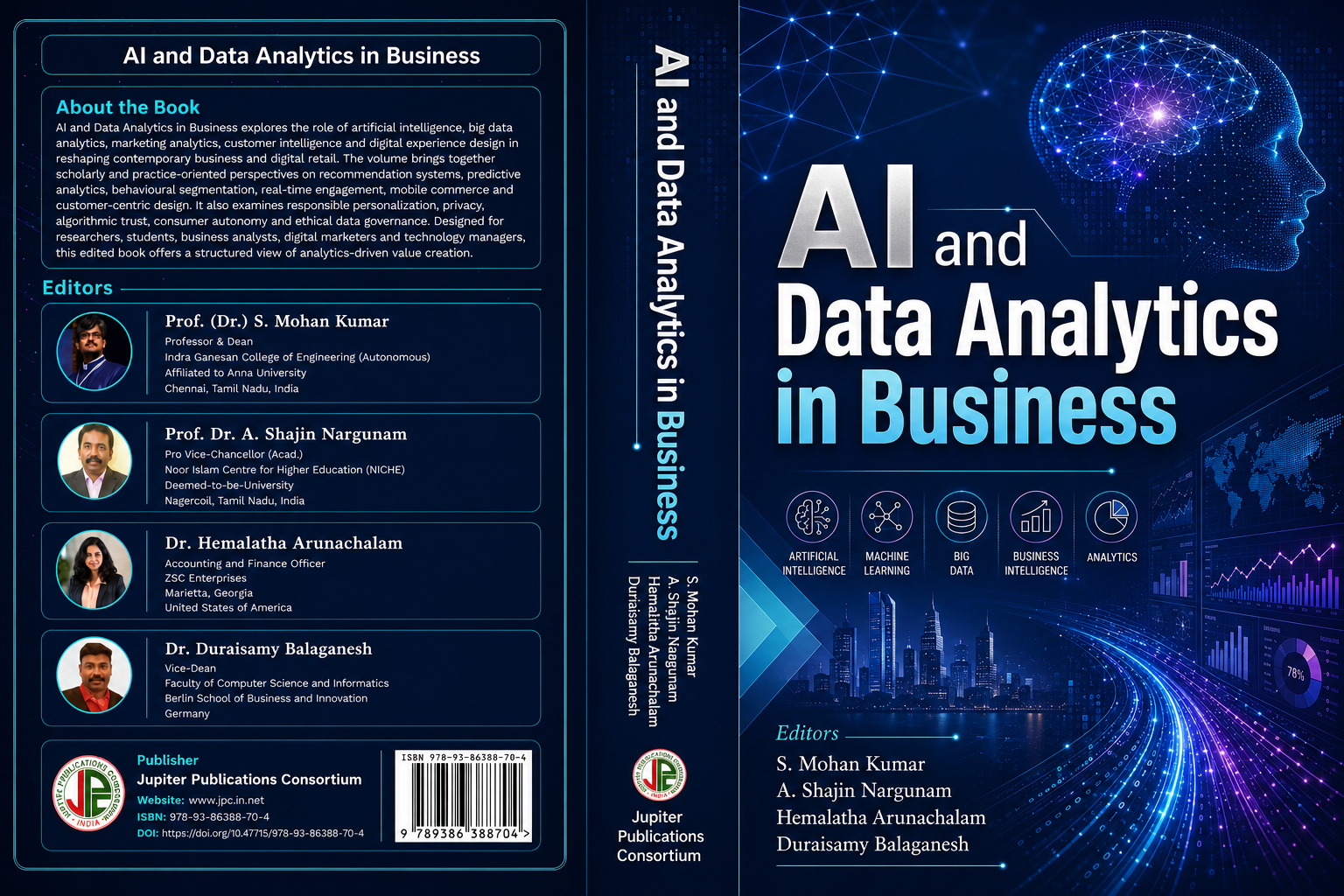
AI and Data Analytics in Business
A scholarly edited volume on artificial intelligence, big data analytics, personalization,
digital retail, customer intelligence, recommender systems, predictive analytics,
mobile commerce, and responsible data-driven business transformation.

Product Description
AI and Data Analytics in Business is a scholarly edited book that examines the transformative role of artificial intelligence, big data analytics, business analytics, predictive modelling, customer intelligence, personalization, recommender systems, mobile commerce, and
digital experience design in contemporary business environments. The book focuses particularly on how analytics and personalization are reshaping digital retail, customer engagement, satisfaction, loyalty, and sustainable value creation.
This edited volume brings together conceptual, analytical, and practice-oriented perspectives on AI-driven business analytics, behavioural targeting, predictive customer retention, loyalty programs, recommender systems, cross-selling techniques, behavioural segmentation, re al-time engagement, customer-centric e-commerce design, co-creation, and ubiquitous mobile commerce experiences. It explains how organizations can convert large-scale customer data into meaningful insights and use those insights for faster decision-making, personalized service delivery, improved marketing performance, customer loyalty, and competitive advantage.
The book also addresses important ethical and managerial concerns associated with AI and analytics, including data privacy, algorithmic transparency, responsible personalization, customer autonomy, fairness, explainability, digital trust, and AI governance. By combining theoretical discussion with practical frameworks, metrics, tables, and figures, the book provides a useful academic and professional
reference for understanding the analytics-personalization nexus in modern business. This book is suitable for academics, researchers, students, digital marketers, business analysts, retail professionals, technology managers, customer experience leaders, policy-oriented readers, and practitioners interested in artificial intelligence, business analytics, digital retail, e-commerce, and data-driven customer engagement.
About the Book
AI and Data Analytics in Business examines the pivotal role of analytics and personalization in shaping consumer behaviour in digital retail. The volume highlights how the integration of artificial intelligence, big data, marketing analytics, customer intelligence, and
digital experience design enables e-commerce platforms to deliver hyper-personalized experiences, improve engagement, and strengthen customer loyalty.
The edited book brings together conceptual, empirical, and practice-oriented perspectives on recommendation systems, predictive analytics, behavioural segmentation, social influence, mobile commerce, and customer-centric design. It also addresses emerging challenges related to privacy, ethics, algorithmic trust, consumer autonomy, and the psychological implications of data-driven shopping environments. The volume is intended for academics, researchers, students, digital marketers, business analysts, retail professionals, technology managers, and policy-oriented readers who seek to understand how analytics and personalization jointly influence satisfaction, loyalty, and value creation in contemporary
digital retail.
Book Keywords
- Artificial Intelligence
- Data Analytics
- Business Analytics
- Big Data
- Digital Retail
- Predictive Analytics
- Customer Retention
- Recommender Systems
- Behavioural Segmentation
- Mobile Commerce
- Customer-Centric Design
- Personalization
- E-Commerce
- Customer Loyalty
- AI Governance
- Responsible Analytics
Publication Details
| Title | AI and Data Analytics in Business |
|---|---|
| Book Type | Edited Book |
| Editors | S. Mohan Kumar; A. Shajin Nargunam; Hemalatha Arunachalam; Duraisamy Balaganesh |
| Publisher | Jupiter Publications Consortium |
| Publisher Address | 22/102 Second Street, Virugambakkam, Chennai–600092, Tamil Nadu, India |
| Phone | +91 97909 11374 | 99625 78190 |
| director@jpc.in.net | |
| Website | https://www.jpc.in.net |
| E-ISBN | 978-93-86388-70-4 |
| Book DOI | https://doi.org/10.47715/978-93-86388-70-4 |
| Edition | First Edition |
| Published On | 12th May, 2026 |
| Number of Pages | 312 |
| Access Type | Full Open Access Volume |
Book and Chapter DOI URLs
The following DOI URLs provide persistent digital access to the edited book and its individual chapters.
| Book DOI | https://doi.org/10.47715/978-93-86388-70-4 |
|---|---|
| Chapter 1 DOI | https://doi.org/10.47715/978-93-86388-70-4/Ch1 |
| Chapter 2 DOI | https://doi.org/10.47715/978-93-86388-70-4/Ch2 |
| Chapter 3 DOI | https://doi.org/10.47715/978-93-86388-70-4/Ch3 |
| Chapter 4 DOI | https://doi.org/10.47715/978-93-86388-70-4/Ch4 |
| Chapter 5 DOI | https://doi.org/10.47715/978-93-86388-70-4/Ch5 |
| Chapter 6 DOI | https://doi.org/10.47715/978-93-86388-70-4/Ch6 |
| Chapter 7 DOI | https://doi.org/10.47715/978-93-86388-70-4/Ch7 |
Editors
Prof. (Dr.) S. Mohan Kumar
Professor & Dean
Indra Ganesan College of Engineering (Autonomous)
Affiliated to Anna University
Chennai, Tamil Nadu, India
Prof. Dr. A. Shajin Nargunam
Pro Vice-Chancellor (Acad.)
Noor Islam Centre for Higher Education (NICHE)
Deemed-to-be-University
Nagercoil, Tamil Nadu, India
Dr. Hemalatha Arunachalam
Accounting and Finance Officer
ZSC Enterprises
Atlanta, Georgia
United States of America
Dr. Duraisamy Balaganesh
Vice-Dean
Faculty of Computer Science and Informatics
Berlin School of Business and Innovation
Germany
Chapters Included in the Book
The edited book contains seven chapters covering AI-driven decision-making, big data analytics,
predictive retention, recommender systems, behavioural segmentation, customer-centric e-commerce
design, and mobile commerce.
Chapter 2: Big Data Analytics and Behavioural Targeting
Chapter 3: Predictive Analytics for Customer Retention
Chapter 4: Recommender Systems and Cross-Selling
Chapter 5: Behavioral Segmentation and Real-Time Engagement
Chapter 6: Customer-Centric Design in E-Commerce
Chapter 7: Mobile Commerce and Ubiquitous Customer Experiences
Individual Chapter Abstracts and Keywords
AI-Driven Business Analytics and Its Role in Reducing Decision-Making Time for Strategic Leaders
Abstract
Artificial intelligence is reshaping business analytics by reducing the time required to collect evidence, interpret complex signals, evaluate strategic alternatives, and convert insights into executive action. This chapter examines how AI-driven business analytics supports strategic leaders who must make timely decisions under uncertainty, competitive pressure, and information overload. It explains the technological foundations of AI analytics, including machine learning, predictive modeling, natural-language interfaces, simulation, optimization, and decision intelligence, while also assessing the organizational conditions that determine whether these technologies create reliable value.
The chapter argues that decision-time reduction is not achieved through automation alone. It depends on data quality, analytics architecture, leadership sponsorship, organizational readiness, AI literacy, human oversight, governance, explainability, and adoption routines. A sociotechnical perspective is used to connect AI capabilities with decision processes, human judgment, organizational culture, and ethical accountability. The chapter also presents practical formulas, evaluation metrics, implementation frameworks, tables, and figures that can guide organizations in measuring decision-cycle improvement and managing AI risks. It concludes that AI-driven analytics can accelerate strategic decisions when it is implemented as a governed decision system rather than as a standalone technology tool.
Keywords
Business analytics
Strategic decision-making
Decision speed
Organizational readiness
AI governance
Big Data Analytics and Behavioural Targeting in Digital Retail
Abstract
This chapter examines how big data analytics reshapes digital retail by converting large volumes of behavioural, transactional, contextual, and operational data into targeted decisions. Digital retailers now observe the customer journey through search queries, clicks, dwell time, baskets, payments, returns, loyalty records, service interactions, mobile location signals, and social responses. These signals do not
have value because they are numerous. They become commercially useful when they are governed, integrated, interpreted, and converted into timely interventions that improve customer relevance while protecting trust. The chapter explains the main data sources used in retail analytics, the architecture required to transform raw event streams into actionable insights, and the analytical methods behind segmentation, propensity modelling, recommender systems, dynamic offers, and customer lifetime value management. It also considers
the organisational and ethical conditions that determine whether behavioural targeting strengthens or damages customer relationships. Particular attention is given to privacy, consent, fairness, explainability, experimentation, measurement, and accountability. The chapter argues that behavioural targeting should be understood not as a narrow advertising technique but as a decision system operating across merchandising, marketing, pricing, service design, and fulfilment. Retailers that combine analytical sophistication with disciplined governance are better placed to deliver personalised experiences that are useful, measurable, and legitimate.
Keywords
Behavioural targeting
Digital retail
Customer journey
Customer segmentation
Recommender systems
Data governance
Customer trust
Predictive Analytics for Customer Retention and Loyalty Programs
Abstract
Predictive analytics has become central to customer retention and loyalty program management because firms must identify which customers are likely to leave, which customers are likely to grow, and which interventions can preserve long-term relationship value. This chapter examines how predictive analytics transforms retention from a reactive activity into a proactive decision system. It discusses retention and loyalty concepts, customer data foundations, feature engineering, churn prediction, customer lifetime value modeling, predictive segmentation, personalized retention strategy, loyalty program design, business impact measurement, and responsible governance. The chapter emphasizes that retention analytics is not simply a technical modeling exercise; it is a managerial capability that connects data, models, customer experience, marketing action, and financial performance. Special attention is given to churn probability, lifetime value, reward propensity, next-best-action logic, experimentation, privacy, fairness, and explainability. A practical implementation roadmap is offered for organizations seeking to strengthen customer loyalty while protecting trust and avoiding excessive or inappropriate targeting.
Keywords
Customer retention
Churn prediction
Loyalty programs
Customer lifetime value
Personalization
Retention governance
Recommender Systems and Cross-Selling Techniques in Online Retail
Abstract
Online retail platforms depend on recommender systems to convert high-volume behavioral data into personalized product discovery, basket expansion, and cross-selling opportunities. This chapter examines the technical and managerial foundations of recommender systems in online retail, with special emphasis on collaborative filtering, content-based filtering, hybrid models, association rules, deep learning, graph learning, contextual personalization, and large language model supported recommendation. The discussion connects algorithmic design with business outcomes such as conversion, average order value, customer lifetime value, retention, and customer experience. It also explains how cross-selling differs from upselling and how both strategies can be operationalized through product affinity, basket analysis, sequential purchase prediction, and real-time ranking. The chapter further addresses evaluation metrics, experimentation, data governance, privacy, fairness, explainability, cold-start mitigation, and deployment architecture. By integrating formulas, tables, implementation considerations, and figure placeholders, the chapter provides a complete academic and practical framework for understanding how modern online retailers design, evaluate, and govern recommender systems that improve commercial performance while preserving customer trust.
Keywords
Cross-selling
Online retail
Collaborative filtering
Personalization
Customer lifetime value
Behavioral Segmentation and Real-Time Engagement Strategies in Smart Retail
Abstract
Smart retail has moved beyond static demographic targeting toward behavior-centric decision making in which retailers observe how customers browse, search, compare, purchase, return, and respond across digital and physical channels. This chapter examines how behavioral segmentation and real-time engagement strategies enable retailers to convert continuous customer signals into timely, context-aware actions that improve relevance, loyalty, and commercial performance.
It discusses the data foundation of smart retail, major segmentation methods, dynamic segment refresh, next-best-action orchestration, omnichannel engagement, experimentation, privacy-aware activation, and managerial implementation issues. Special attention is given to the integration of rule-based approaches, machine learning, feature stores, event streams, customer data platforms, and responsible governance practices. The chapter argues that effective smart retail is not simply about collecting more data; it is about transforming
behavioral evidence into trusted, explainable, and measurable interventions delivered at the right time through the right channel. A conceptual and practical roadmap is offered for retailers seeking to design scalable behavioral segmentation systems and real-time engagement programs that are simultaneously customer-centric, operationally feasible, and economically valuable.
Keywords
Smart retail
Real-time engagement
Omnichannel personalization
Customer data platform
Retail analytics
Customer-Centric Design in E-Commerce: From Personalization to Co-Creation
Abstract
Customer-centric design in e-commerce has evolved from simple interface optimization and product display logic to sophisticated, data-enabled systems that personalize content, anticipate needs, orchestrate journeys, and invite customers to participate in value creation. This chapter examines the conceptual, analytical, technological, and managerial foundations of customer-centric design in e-commerce, tracing the movement from personalization to co-creation.
It explains how retailers and digital platforms use customer insight, experience design, segmentation, recommendation systems, generative artificial intelligence, journey analytics, and participatory mechanisms to deliver relevant, trustworthy, and inclusive experiences. The chapter also analyzes how co-creation extends the scope of design by incorporating customer feedback, customization choices, community interaction, and innovation input into digital commerce strategy.
In addition, the chapter discusses measurement frameworks, key performance indicators, ethical and privacy considerations, and implementation challenges in designing responsive and responsible e-commerce systems. Eight figures, multiple tables, and practical formulas are used to illustrate the architecture, workflow, evaluation logic, and governance requirements of customer-centric e-commerce. The chapter concludes that the next stage of digital commerce depends on combining personalization efficiency with participatory design, transparency, and ongoing learning so that firms can create sustainable value for both businesses and customers.
Keywords
E-commerce
Personalization
Co-creation
Customer experience
Recommendation systems
Digital commerce
Journey analytics
Generative AI
Privacy
Mobile Commerce and the Optimization of Ubiquitous Customer Experiences
Abstract
Mobile commerce has transformed retail from a channel-specific activity into a ubiquitous customer experience in which consumers discover, evaluate, purchase, pay, receive service, and remain loyal through mobile devices. This chapter examines how mobile commerce optimizes customer experience through context-aware design, mobile applications, wallets, location services, real-time analytics, artificial intelligence, and omnichannel integration.
It explains how mobile customer data, behavioral signals, payment infrastructure, app design, push notifications, and journey analytics combine to create experiences that are seamless, secure, personalized, and available at the moment of need. The chapter also discusses how retailers and digital platforms can reduce friction across onboarding, search, checkout, fulfillment, service, and loyalty stages. Special attention is given to mobile personalization, secure payment architecture, app engagement, privacy, fraud monitoring, and trust governance.
Tables, formulas, and high-resolution figures are used to connect theoretical concepts with managerial implementation. The chapter argues that mobile commerce success is not merely a function of screen size or app availability; it depends on the firm’s ability to integrate contextual intelligence, customer-centered design, operational reliability, and responsible data use into a continuous mobile experience system.
Keywords
Ubiquitous customer experience
Mobile personalization
App engagement
Mobile payments
Location-based services
Customer journey optimization
M-commerce analytics
Privacy
Trust
Contributors
Dr. R. Sakthivel
Professor, Government Arts College, Tiruppur, Tamil Nadu, India
Contributed Chapter: Chapter 1, “AI-Driven Business Analytics and Its Role in Reducing Decision-Making Time for Strategic Leaders”
Dr. G. Senthil Velan
Assistant Professor, Department of Computer Science and Engineering, Dr. M. G. R Educational and Research Institute, Chennai, Tamil Nadu, India
Contributed Chapter: Chapter 2, “Big Data Analytics and Behavioural Targeting in Digital Retail”
Dr. J. Jerlin Violet
Assistant Professor & Head, Department of Business Administration, St. Thomas College of Arts and Science, Koyambedu, Chennai
Email: drjerlinviolet@gmail.com
ORCID iD: 0009-0007-6462-1761
Contributed Chapters: Chapter 3, “Predictive Analytics for Customer Retention and Loyalty Programs”; Chapter 4, “Recommender Systems and Cross-Selling Techniques in Online Retail”
Dr. H. Josiah
Head of the Department, Department of Business Administration, T.J.S. College of Arts and Science, Peruvoyal, Near Red Hills, Chennai–601206
Email: hjosiah2000@gmail.com
ORCID iD: 0009-0007-6462-1761
Contributed Chapters: Chapter 3, “Predictive Analytics for Customer Retention and Loyalty Programs”; Chapter 4, “Recommender Systems and Cross-Selling Techniques in Online Retail”
Dr. Archana Kumari
Department of Information Technology, Indra Ganesan College of Engineering, Tiruchirappalli, Tamil Nadu–620012
Email: dr.archanakumari.p@gmail.com
Contributed Chapter: Chapter 5, “Behavioral Segmentation and Real-Time Engagement Strategies in Smart Retail”
Dr. G. Umadevi
Professor, Computer Science and Engineering, University of Engineering and Management, Jaipur, Rajasthan, India
Contributed Chapter: Chapter 6, “Customer-Centric Design in E-Commerce: From Personalization to Co-Creation”
Dr. D. Shanthi Revathi
Head & Associate Professor in Business Administration, SAS School of Arts and Science, Paiyanoor, Chennai–603104, Tamil Nadu, India
Contributed Chapter: Chapter 7, “Mobile Commerce and the Optimization of Ubiquitous Customer Experiences”
How to Use This Edited Book
AI and Data Analytics in Business has been designed as a structured academic and professional resource for understanding how analytics, artificial intelligence, personalization, and digital technologies are reshaping customer satisfaction and loyalty in digital retail. The chapters may be read sequentially as a complete progression from analytics foundations to customer experience design, mobile commerce, and responsible digital retailing. Readers may also consult individual chapters selectively according to their research, teaching, professional, or implementation needs.
The opening chapters establish the analytical foundation of the volume. Chapter 1 introduces AI-driven business analytics and explains how artificial intelligence supports faster and more informed strategic decision-making. Chapter 2 extends the discussion to big data analytics and behavioural targeting in digital retail, showing how large-scale customer data can be transformed into segmentation, targeting, and personalized engagement. Chapter 3 focuses on predictive analytics for customer retention and loyalty programs, emphasizing how firms can identify churn risk, design retention strategies, and strengthen long-term customer relationships.
The middle chapters examine personalization and customer engagement mechanisms in greater depth. Chapter 4 discusses recommender systems and cross-selling techniques in online retail, providing insight into collaborative filtering, content-based recommendation, hybrid systems, basket analysis, and recommendation evaluation. Chapter 5 addresses behavioural segmentation and real-time engagement strategies in smart retail, explaining how customer signals can be converted into next-best actions, omnichannel interventions, and timely customer engagement. Chapter 6 develops the theme of customer-centric design by tracing the movement from personalization to
co-creation in e-commerce.
Chapter 7 focuses on mobile commerce and the optimization of ubiquitous customer experiences. It explains how mobile applications, mobile payments, contextual intelligence, location-based services, push notifications, artificial intelligence, and omnichannel integration contribute to seamless and secure customer experiences. Together, these chapters provide a multi-dimensional understanding of how digital retailers can move from data collection to customer insight, from customer insight to personalization, and from personalization to loyalty and sustainable value creation.
For students and academic readers, this book can be used as a learning text for courses in e-commerce, digital marketing, retail analytics, business analytics, artificial intelligence in management, customer relationship management, and information systems. For researchers, the volume offers a consolidated view of current themes in analytics-enabled digital retail. For practitioners and managers, the book may be used as a strategic guide for designing data-driven retail initiatives.
For policy-oriented and ethics-focused readers, the volume also provides insight into the governance challenges of data-driven retail. Although the book emphasizes commercial innovation, it also recognizes that analytics and personalization must be implemented responsibly. Issues such as privacy, consent, fairness, transparency, algorithmic accountability, customer autonomy, and digital trust should be considered alongside business performance.
Open Access, Copyright and Responsibility Statements
Open Access Statement
This edited book is published as a full open access volume. Readers may freely read, download, copy, print, share, and cite the chapters for academic, teaching, research, and scholarly communication purposes, provided that proper attribution is given to the authors, editors, title of the book, publisher, and publication details.
No subscription fee, access fee, or paywall is required to access this book. Open access availability is intended to support wider academic dissemination, research visibility, teaching use, and knowledge sharing.
Copyright Notice
Copyright © 2026 by the editors, authors, and publisher. The copyright of individual chapters remains with the respective chapter authors, while the edited volume is published and distributed by Jupiter Publications Consortium.
Although this book is made available as a full open access publication, proper citation and acknowledgement are required for all academic and professional use. Reproduction, redistribution, translation, adaptation, or reuse of substantial parts of the work for commercial purposes should be carried out only with appropriate acknowledgement and, where required, with permission from the publisher or the respective copyright holder.
Author Responsibility Statement
The views, interpretations, findings, arguments, and conclusions expressed in the individual chapters are those of the respective authors and do not necessarily reflect the views of the editors or publisher. The authors are responsible for the originality, accuracy, citation integrity, permissions, ethical compliance, and scholarly quality of their respective chapters.
Disclaimer
The editors and publisher have taken reasonable care in the preparation and publication of this edited volume. However, they shall not be held responsible for errors, omissions, copyright issues, reference inaccuracies, data misinterpretation, or consequences arising from the use of the material contained in this book.
Suggested Citation
Mohan Kumar, S., Shajin Nargunam, A., Arunachalam, H., & Balaganesh, D. (Eds.). (2026).
AI and Data Analytics in Business. Jupiter Publications Consortium.
https://doi.org/10.47715/978-93-86388-70-4


Reviews
There are no reviews yet.