

Abstract
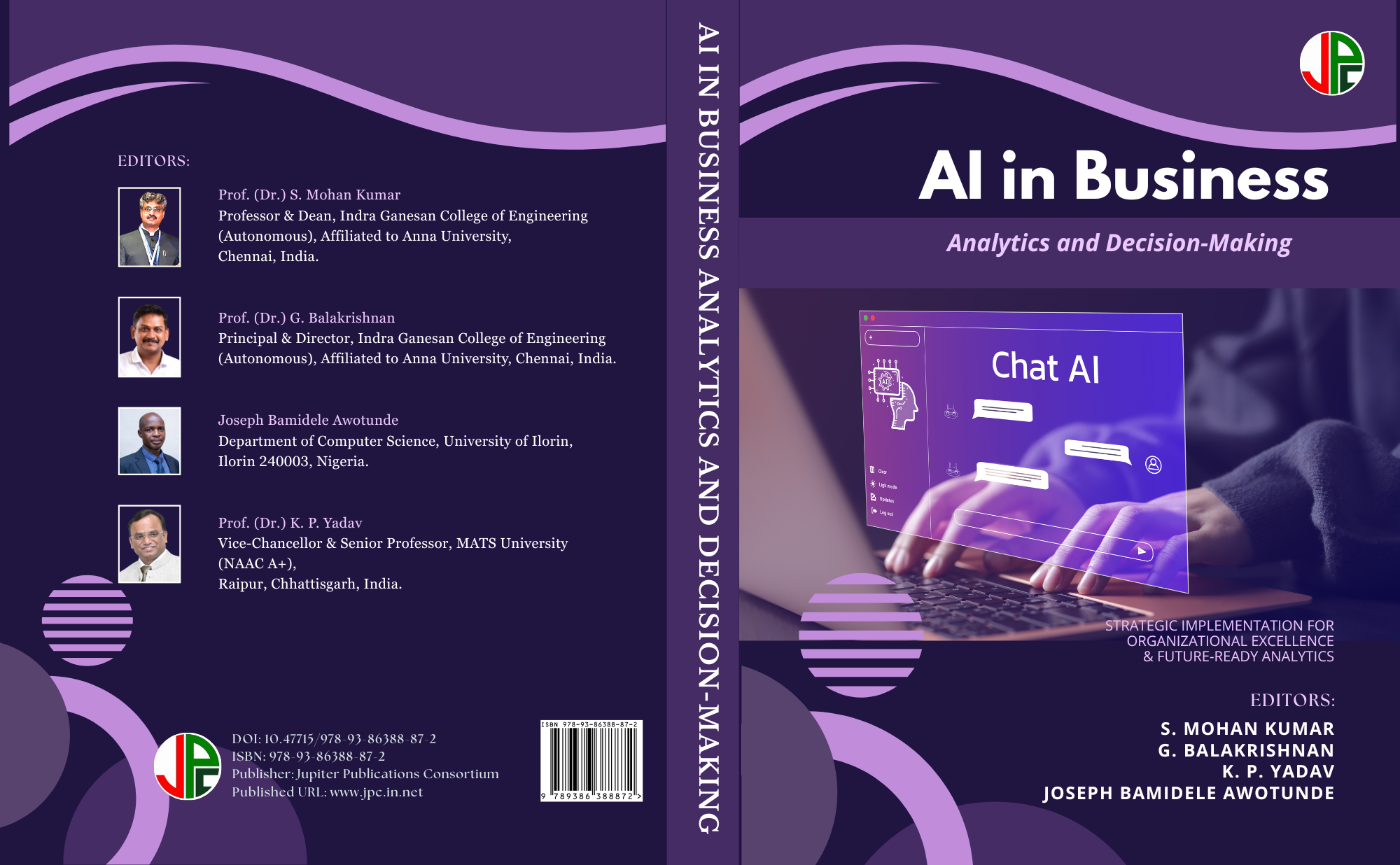
This edited volume examines the rapidly evolving intersection of Artificial Intelligence (AI), Machine Learning (ML), and business analytics, offering a comprehensive analysis of how these technologies redefine organizational decision-making and competitive strategy. The book explores a broad spectrum of themes, including enterprise-scale AI implementation, predictive and prescriptive analytics integration, data governance, organizational readiness, ethical frameworks, and future-focused analytical capabilities. Contributions span multiple domains such as e-commerce sentiment analysis, digital transformation, AI-enabled strategic decision-making, IoT-driven quality monitoring, workforce AI literacy, and chatbot-driven retail innovation. Drawing from empirical research, case studies, theoretical frameworks, and emerging technological trends, the volume highlights both the opportunities and challenges associated with AI adoption—including algorithmic performance, real-time adaptability, data quality, privacy, and sociotechnical tensions. The collective insights emphasize the need for scalable, interpretable, and ethically governed AI systems that align with organizational culture and strategic goals. This work serves as a critical resource for researchers, practitioners, executives, and policymakers seeking to advance organizational excellence through AI-driven analytics and future-ready decision-making.
Keywords
Artificial Intelligence, Machine Learning, Business Analytics, Decision-Making, Predictive Analytics, Prescriptive Analytics, Data Governance, Digital Transformation, Organizational Readiness, AI Ethics, Sentiment Analysis, E-Commerce Marketing, Big Data Analytics, Chatbots, Generative AI, IoT, Edge AI, Workforce Transformation, AI Literacy, Strategic Management, Data-Driven Decision-Making, Reinforcement Learning, Multimodal Analytics.
Chapter 1: Machine Learning Algorithms for Sentiment-Based E-Commerce Marketing
ARCHANA KUMARI
Indra Ganesan College of Engineering, Tiruchirappalli, Tamil Nadu 620012,
Department of Information Technology
dr.archanakumari.p@gmail.com
Chapter DOI: https://doi.org/10.47715/978-93-86388-87-2/ch1
Abstract
Altering consumer behavior prediction and optimizing marketing campaigns on social media has resulted in complex challenges in accurately detecting consumer sentiment and improving the impact of marketing in e-commerce. This review aims to expose current algorithm sentiment analysis on social media in e-commerce marketing. This review aims to expose the challenges in the execution of current model sentimentizers and evaluate their potential in traditional and new model integration. Concurrent real-time sentiment analysis with reinforcement learning in the context of marketing was also examined. More than 70 research papers have applied classical machine learning and deep learning, transformers, and hybrid models. The focus of the review was algorithmic effectiveness, real-time marketing impact, business interpretability, and legal ambiguity on marketing loops. The analysis indicates that the transformer model in complex tasks provides real-time results with reinforcement learning. Real-time echo models and predictive solicitude highlight the need to address accumulated technology in ethics and scale. The hybrid and ensemble models exhibit the lowest and located challenge towards explainability and prediction for the analysis set of models used. This examination highlights the necessity of designing scalable and interpretable systems that tackle the complexities of a diverse data ecosystem, along with ethical and pragmatic concerns. This sets the stage for more sophisticated and applied investigations into the interface between AI and consumer behavior prediction for the enhancement of e-commerce marketing.
Keywords: sentiment analysis, machine learning, e-commerce marketing, consumer behavior prediction, deep learning, transformer models
Chapter 2: Organizational Readiness and Change Management in the Age of AI-Driven Business Analytics
HEMALATHA ARUNACHALAM
Finance Manager, ZSC Enterprises, Marietta, Georgia, USA
hemalathaa@zscenterprises.com
Chapter DOI: https://doi.org/10.47715/978-93-86388-87-2/ch2
Abstract
Organizational readiness has crystallized as a principal determinant of success in managed change within turbulent contexts. This chapter reconceptualizes readiness as a composite framework encompassing psychological alignment, cultural resonance, structural competency,
and technological fitness. Building on empirical studies of healthcare reform, enterprise digital transformation, and Industry 4.0, the analysis demonstrates that readiness is a reliable predictor of implementation success, a regulator of resistance, and a facilitator of sustained change. It devotes special attention to the preconditions that must be satisfied to embed artificial intelligence and advanced analytics within decision-making processes. Effective AI integration demands constant, enterprise-level commitment that transcends purely technological expenditure—it is ultimately contingent upon the simultaneous readiness of human, procedural, and data domains. Organizations that develop this portfolio of capacities are in a stronger position to translate AI-generated insights into demonstrable value; however, neglecting holistic readiness exposes firms to inefficient resource deployment and project abandonment. The chapter argues that leadership behavior and prevailing cultural norms serve as essential moderators, influencing whether preparedness is amplified or eroded during transformation. By weaving together a rigorous theoretical foundation, robust empirical validation, and practical managerial guidance, the work repositions readiness as a continuously evolving suite of capabilities. The proposed framework not only enriches scholarly debate but also offers stepwise, implementable directives,thereby embedding readiness into AI-supported organizations and strengthening their capacity to withstand uncertainty and to base future decisions on consistently available insights.
Keywords: Organizational readiness, Change management, Artificial intelligence adoption,Business analytics and decision-making, Digital transformation, Industry 4.0
Chapter 3: Challenges in Implementing Big Data Analytics for Behavioral Targeting in Digital Retail: Emphasizing Difficulties in Data Collection, Processing, and Ensuring User Privacy
ARUL ELANGO
Manipal Institute of Technology, Manipal Academy of Higher Education, Manipal, India
arulelango2012@gmail.com
Chapter DOI: https://doi.org/10.47715/978-93-86388-87-2/ch3
Abstract
This chapter aims at “addressing the complex challenges in the acquisition, management, and ethical use of the data as identified in the review behavioral targeting in digital retail: the implementation of big data analytics and challenges in data collection, data processing, and user privacy”. The review sought to understand the challenges in the data collection process, assess the techniques for data processing, identify the privacy and ethical issues, the level of technological privacy, and the trust and regulatory frameworks. An interdisciplinary approach relying on empirical, conceptual, and technological studies of the available literature within the context of digital retail was used. The findings indicate the existence of silos of data fragmentation and other barriers to integration. This is despite the advancement of privacy-preserving collection techniques like federated learning. The existence of resource- and bias-related challenges limits the processing scalability of deep learning and synthetic data techniques. The data protection frameworks that incorporate differential privacy and blockchain are unable to diffuse consumer skepticism and ethical dilemmas. Compliance to GDPR and CCPA is important but difficult due to the fragmented governance and operational constraints. The lack of proper mechanisms for maintaining transparency and user control contributes to the unresolved privacy-personalization paradox which makes trust difficult to achieve. These results emphasize the importance of having open and ethically defendable frameworks for big data analytics that are balanced in their offering of personalization and privacy. The review determines areas where future research and practice could focus behavioral targeting optimization within a privacy preserve framework in digital retailing.
Keywords: Big data analytics, behavioral targeting, digital retail, privacy preservation, ethical frameworks, consumer trust, GDPR, federated learning
Chapter 4: Advanced Applications and Strategic Implications of AI Chatbots in E-Commerce
R SAKTHIVEL
Professor, Government Arts College, Tiruppur. sakthi19_69@yahoo.co.in
Chapter DOI: https://doi.org/10.47715/978-93-86388-87-2/ch4
Abstract
This chapter explores the intricacies of key technologies, business strategies, and evolving ethical aspects of AI chatbots within e-commerce. It uses peer-reviewed publications and industry case studies to examine the influence of generative AI, retrieval-augmented generation, multimodal fusion, and predictive analytics on the evolution of retail customer experience, operational effectiveness, and business model innovation. It analyzes operational efficiencies, business value, and customer equity improvements arising from chatbot utilization while addressing data quality, system integration equity, privacy, and sociotechnical change. It provides specific recommendations on responsible AI governance and serves as an exemplary guide on digital transformation to retailers as a foreword to the chapter. It discusses the expanding domain of conversational commerce and next-generation customer engagement as well. Keywords: AI chatbots, e-commerce, natural language processing, generative AI, customer experience, operational efficiency, personalization, data privacy, algorithmic fairness, retail strategy, business transformation, conversational commerce, digital governance
Chapter 5: IOT-Driven Innovations in Fruits and Vegetables Quality Monitoring: From Sensors To Edge AI
B. Babu
Associate Professor, Indra Ganesan College of Engineering, Manikandam, Trichy
K. Vanisri, S. Sumathra, and N. Ramanarayanan
Assistant Professor, Indra Ganesan College of Engineering, Manikandam, Trichy
Corresponding author: babuamr11@gmail.com
Chapter DOI: https://doi.org/10.47715/978-93-86388-87-2/ch5
Abstract
This review highlights recent advances in sensing technologies, embedded systems, and machine learning for the automated quality assessment of fruits and vegetables, with a particular focus on Internet of Things (IoT)-enabled solutions. These systems support real-time monitoring, remote alerts, and improved supply-chain visibility. The survey encompasses diverse sensing modalities, including visual, gas/e-nose, optical, mechanical/texture, and spectroscopic methods, as well as embedded and edge architectures. It further examines data analytics approaches, ranging from classical machine learning to lightweight convolutional neural networks optimized for edge devices. Representative implementations are discussed, along with practical challenges such as power efficiency, sensor calibration, selectivity, and data reliability. The review also explores future directions, including edge AI, digital twins, federated learning, and sustainable hardware. Overall, findings reveal a clear progression from basic environmental monitoring toward multimodal, AI-enabled edge devices that deliver actionable insights on freshness and grading to stakeholders across the agricultural value chain.
Keywords: Fruits and Vegetables, Fruits and Vegetables, Food Quality Monitoring, Computer Vision, Machine Learning / Deep Learning, Edge Computing, Digital Twins in Agriculture.
Chapter 6: AI-Driven Business Analytics and Its Role in Reducing Decision-Making Time for Strategic Leaders
R SAKTHIVEL
Professor, Government Arts College, Tiruppur. sakthi19_69@yahoo.co.in
Chapter DOI: https://doi.org/10.47715/978-93-86388-87-2/ch6
Abstract
This systematic review synthesizes 50 multidisciplinary studies published between 2020 and 2025 to examine the interplay between AI technological capabilities and organizational factors in accelerating strategic decision-making. The review addresses four critical research objectives: (1) evaluating current AI technologies that enhance business analytics and decision speed; (2) benchmarking organizational factors influencing AI adoption; (3) identifying integration challenges and facilitators; and (4) comparing technological innovations with organizational implications. The reviewed literature demonstrates that successful AI-driven decision-making requires a sociotechnical paradigm integrating technical innovations with organizational culture, leadership dynamics, ethical governance, and human agency. Key findings reveal that organizational readiness—encompassing data-driven culture, supportive leadership, continuous training, and robust ethical frameworks—is central to AI implementation effectiveness. Furthermore, human-AI collaboration, where artificial systems augment rather than replace human judgment, emerges as essential for preserving ethical accountability and organizational resilience. The synthesis identifies critical research gaps including limited longitudinal evidence, sector-specific variation analysis, and detailed implementation strategies for overcoming adoption barriers. Organizations embracing sociotechnical integration achieve accelerated decision-making and improved decision quality, while those treating AI as discrete technical projects experience minimal benefits and substantial implementation barriers.
Keywords: artificial intelligence, business analytics, strategic decision-making, organizational readiness, human-AI collaboration, sociotechnical systems, ethical governance, leadership transformation
Chapter 7: AI Literacy and Workforce Transformation
HEMALATHA ARUNACHALAM
Finance Manager, ZSC Enterprises, Marietta, Georgia, USA. hemalathaa@zscenterprises.com
Chapter DOI: https://doi.org/10.47715/978-93-86388-87-2/ch7
Abstract
Artificial Intelligence (AI) has become a disruptive technology that is transforming the face of education, industry, and society. This rapid alignment has posed a two-song necessity to develop AI literacy and navigate workforce changes. AI literacy is not confined to technical proficiency alone; it is broader, encompassing knowledge, critical judgment, ethical judgment, and socio-cultural consciousness. Workforce transformation, in turn, indicates the impacts of AI on work (in terms of automation and augmentation) to reorganize work and job structure and to alter the necessary skills. This chapter has synthesized the last 40 open-access reports published between 2023 and 2025, basing its evidence on education, human resource management, and organizational practice. The methodology used was narrative synthesis, which involves background coding in areas of literacy systems, educational interventions, and workforce adaptations. The findings demonstrate that AI literacy is multidimensional; education offers context for literacy pipelines. Workforce transformation is remarkably hastened in HR and organizational practices. Literacy acts as a facilitator of adaptability and resilience. However, unresolved issues remain, including inequities, ineffective measurement instruments, and fragmented models. The discussion focuses on AI literacy as the interface that connects education to the labor force, allowing people to be critical and companies to be innovative without diminishing the lives of others. The conclusion emphasizes that a transformation of the workforce may be discriminatory and inequitable without explicit efforts being made to improve literacy. The future looks promising in terms of cross-sectoral frameworks, interventions with a focus on equity, AI-enhanced learning ecosystems, and models of human-AI collaboration. The chapter provides a timely insight into how to achieve sustainable change in the human workforce by positioning AI literacy as a key driver of change within institutions and the rural workforce.
Keywords: AI literacy, workforce transformation, human–AI collaboration, education, ethical AI, adaptability


Reviews
There are no reviews yet.