

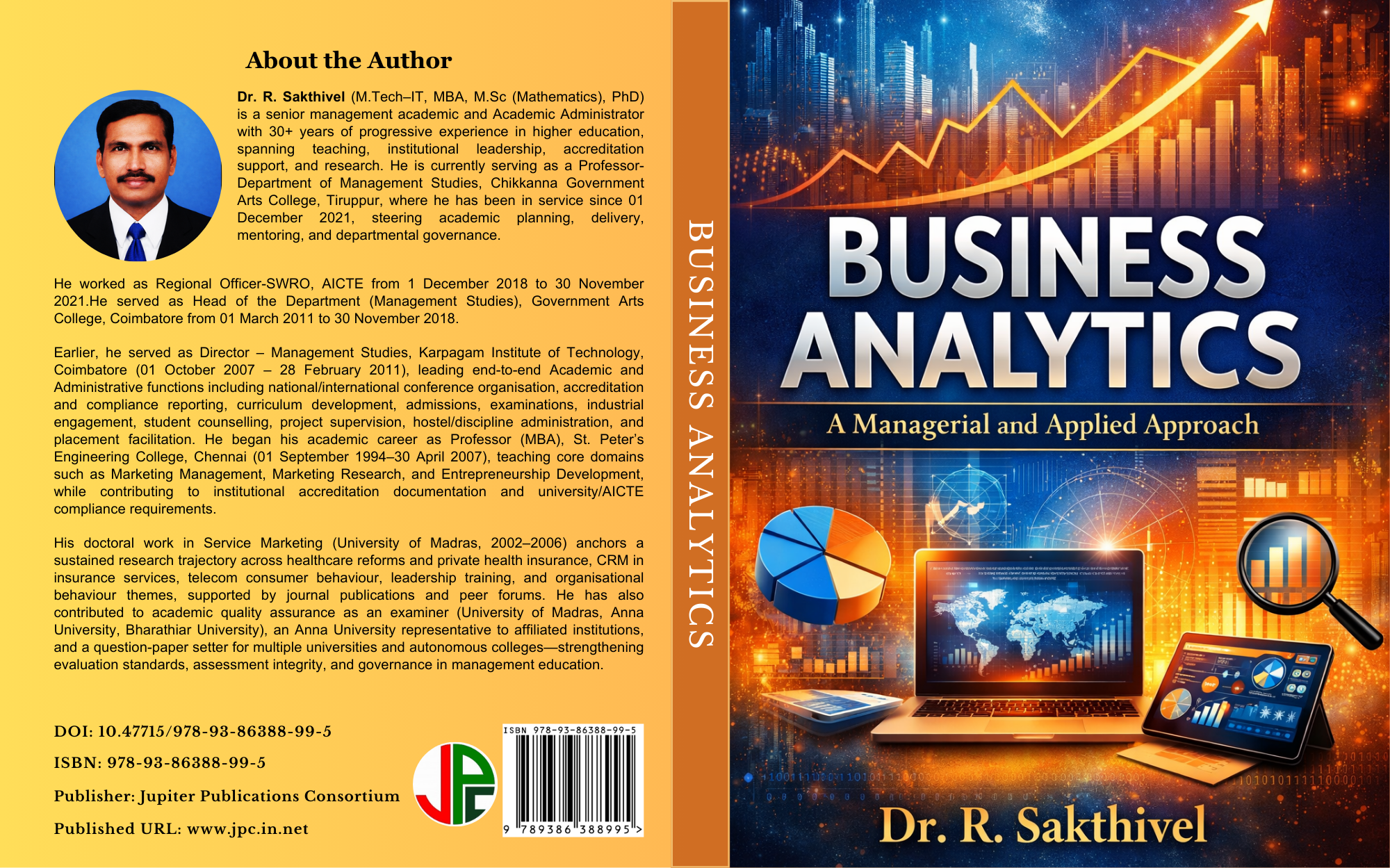
Book Overview
Business Analytics: A Managerial and Applied Approach presents analytics as a decision discipline for managers, MBA learners, and working professionals. The book develops a practical framework for converting data into measurable business value through problem framing, data foundations, visualization, statistical thinking, predictive modeling, forecasting, optimization, experimentation, and responsible implementation. It is structured to support both end-to-end learning and practical managerial use in areas such as customer analytics, operations, finance, and risk.
Abstract
Business Analytics equips managers, MBA learners, and working professionals with a decision-first framework for converting data into measurable business value. Rather than presenting analytics as a purely technical discipline, this book integrates strategy, execution, and quantitative reasoning to help readers frame problems, select appropriate methods, interpret results responsibly, and communicate insights that drive action. It begins with a managerial overview of analytics, including its scope, organizational value, decision contexts, and common failure modes, and then establishes the foundations required for trustworthy analysis, such as data sources, structures, quality, preparation, sampling, governance, privacy, and responsible use. The text develops competency across the analytics spectrum through descriptive analytics, KPI design, exploratory analysis, dashboard principles, segmentation, and executive storytelling. It introduces probability, uncertainty, confidence intervals, and hypothesis testing in a managerial and interpretive way, helping readers understand evidence, quantify risk, and avoid common errors in interpretation. Predictive modeling chapters explain workflow, feature reasoning, validation, and evaluation, covering regression, logistic regression, and tree-based methods with business-linked metrics such as lift, calibration, AUC, and cost-sensitive measures. Forecasting and time series are connected to planning decisions in demand, inventory, and workforce. Prescriptive analytics extends insights into action through optimization, simulation, and scenario planning. The book also addresses experimentation, causal inference, customer and revenue analytics, operations and supply chain analytics, financial and risk analytics, and concludes with an implementation playbook covering responsible AI, governance, MLOps, change management, ROI, and OKRs for sustainable organizational impact.
Keywords
business analytics, decision-making, data foundations, descriptive analytics, data visualization, statistical thinking, predictive modeling, time series forecasting, optimization, experimentation, causal inference, responsible AI, analytics governance, MLOps, ROI, OKRs
What This Book Helps Readers Do
- Frame business challenges as analytics problems with clear objectives, constraints, stakeholders, and success measures
- Understand descriptive, diagnostic, predictive, and prescriptive analytics and when each is appropriate
- Build strong foundations in data definitions, data quality, preparation, governance, privacy, and ethical use
- Communicate insights through dashboards, visualization, and decision narratives
- Interpret uncertainty using probability and statistical thinking
- Evaluate predictive models using business-relevant measures such as lift, calibration, AUC, cost, and risk
- Move from prediction to action using optimization, simulation, and scenario planning
- Design and interpret experiments and causal approaches credibly and safely
- Apply analytics across marketing and revenue, operations and supply chain, finance and risk
- Understand implementation realities including operating models, tool choices, governance, MLOps, adoption, ROI, and OKRs
Intended Audience
This book is designed for managers, MBA students, and working professionals who want a practical, decision-first understanding of analytics. It is also useful to faculty, trainers, and organizational leaders seeking a structured framework for evidence-based decision-making and analytics capability building.
Table of Contents
Front Matter
- Foreword
- Acknowledgements
- Abstract
- Preface
- How to Use This Book
- About the Author
- Note to Readers
Chapter 1. Business Analytics: Managerial Overview
- What is Business Analytics? Scope and Value
- Analytics in the MBA Context: Decisions, Strategy, and Execution
- Types of Analytics: Descriptive, Diagnostic, Predictive, Prescriptive
- Analytics Lifecycle: Problem Framing to Deployment
- Analytic Thinking: Hypotheses, Causality, and Trade-offs
- Common Pitfalls: Biases, Misinterpretation, and Overfitting
- Managerial Toolkit: Questions to ask before approving an analytics initiative
- Chapter Summary
- Key Terms
- Review Questions (MBA level)
- Mini Case: Fixing On-Time Delivery at MetroFoods
Chapter 2. Data Foundations for Analytics
- Business Data Sources: ERP, CRM, Web, Social, IoT
- Data Types and Structures: Tables, Time Series, Text, Clickstream
- Data Quality: Completeness, Accuracy, Consistency, Timeliness
- Data Preparation: Cleaning, Transformation, Feature Creation
- Sampling and Data Collection in Business Settings
- Data Governance: Ownership, Privacy, and Compliance
Chapter 3. Descriptive Analytics and Visualization
- KPIs, Dashboards, and Performance Management
- Exploratory Data Analysis (EDA) for Business
- Data Visualization Principles for Managers
- Segmentation Basics: Cohorts, RFM, and Clustering Intuition
- Storytelling with Data: Narratives and Executive Communication
- Common Visualization Mistakes and How to Avoid Them
- Chapter Summary
- Key Terms
- Review Questions (MBA level)
- Mini Case: The Mystery of Rising Stock-outs
- Practical Exercises
Chapter 4. Probability, Uncertainty, and Statistical Thinking
- Uncertainty in Business Decisions
- Probability Concepts for Managers
- Distributions Common in Business Data
- Sampling Distributions and the Central Limit Theorem
- Confidence Intervals and Practical Interpretation
- Hypothesis Testing: p-values, Errors, and Power
- Chapter Summary
- Key Terms
- Review Questions (MBA level)
- Mini Case: Credit Growth vs. Risk at Zenith Bank
Chapter 5. Predictive Modeling for Business
- Predictive Problem Types: Classification vs. Regression
- Model Building Workflow: Train/Test, Validation, Cross-Validation
- Linear Regression for Forecasting and Drivers
- Logistic Regression for Propensity and Risk
- Decision Trees and Ensemble Models: Random Forests, Boosting (Conceptual)
- Model Evaluation: Accuracy, AUC, RMSE, Lift, Calibration
- Managerial Toolkit: A Predictive Model “Model Card” Template
- Chapter Summary
- Key Terms
- Review Questions (MBA level)
- Mini Case: Retention Targeting at MetroFoods
Chapter 6. Business Forecasting and Time Series Analytics
- Forecasting Use Cases: Demand, Sales, Inventory, Workforce
- Time Series Components: Trend, Seasonality, Cycles
- Baseline Methods: Moving Average, Exponential Smoothing
- ARIMA Concepts and When to Use It
- Forecast Accuracy Metrics and Bias
- S&OP and Forecasting in Operations
- Managerial Toolkit: Selecting a Forecasting Approach
- Chapter Summary
- Key Terms
- Review Questions (MBA level)
- Mini Case: Planning Fresh Produce for a Festival Week
Chapter 7. Prescriptive Analytics and Optimization
- From Prediction to Action: Decision Models
- Optimization Basics: Objective, Constraints, Feasibility
- Linear Programming for Allocation and Planning
- Integer Programming for Scheduling and Network Design
- Simulation and What-If Analysis
- Decision Under Uncertainty: Robust and Scenario Planning
- Managerial Toolkit: How to Build a Prescriptive Model
- Chapter Summary
- Key Terms
- Review Questions (MBA level)
- Mini Case: Designing a Peak-Hour Service Plan
Chapter 8. Experimentation, A/B Testing, and Causal Inference
- Why Causality Matters in Business
- Designing Experiments: Randomization and Control
- A/B Testing Metrics: Conversion, Retention, Revenue
- Sample Size, Power, and MDE (Managerial Intuition)
- Quasi-Experiments: Difference-in-Differences, Matching (Conceptual)
- Common Experiment Traps: Novelty, Interference, P-hacking
- Managerial Toolkit: Experiment Design Checklist
- Chapter Summary
- Key Terms
- Review Questions (MBA level)
- Mini Case: Coupon ROI at MetroFoods
Chapter 9. Customer, Marketing, and Revenue Analytics
- Customer Analytics Frameworks: Funnel, Journey, LTV
- Churn Analytics and Retention Strategy
- Pricing Analytics: Elasticity, Promotions, and Price Tests
- Marketing Mix and Attribution (Conceptual)
- Recommendation and Personalization (Managerial View)
- Revenue Management and Capacity Constraints
- Managerial Toolkit: Customer Analytics Operating Dashboard
- Chapter Summary
- Key Terms
- Review Questions (MBA level)
- Mini Case: Profitable Growth Plan for MetroFoods
Chapter 10. Operations and Supply Chain Analytics
- Inventory Analytics: EOQ, Safety Stock, Service Levels
- Process Analytics: Bottlenecks, Cycle Time, Variability
- Quality Analytics: Control Charts and Six Sigma Link
- Logistics and Routing Analytics (Managerial View)
- Workforce and Capacity Planning
- Risk and Resilience in Supply Chains
- Managerial Toolkit: Operations Analytics Playbook
- Chapter Summary
- Key Terms
- Review Questions (MBA level)
- Mini Case: Reducing Stock-outs Without Increasing Waste
Chapter 11. Financial and Risk Analytics
- Analytics for Financial Performance and Value Drivers
- Credit Risk, Fraud, and Anomaly Detection (Conceptual)
- Portfolio Concepts for Managers
- Scenario Analysis and Stress Testing
- KPIs for Finance: Cash Conversion, Margins, ROIC
- Model Risk Management and Controls
- Managerial Toolkit: Finance Analytics Governance Pack
- Chapter Summary
- Key Terms
- Review Questions (MBA level)
- Mini Case: Balancing Growth and Risk at Zenith Bank
Chapter 12. Analytics Strategy, Ethics, and Implementation
- Building an Analytics Operating Model
- Make vs. Buy: Tools, Platforms, and Vendor Evaluation
- MLOps and Model Lifecycle Management (MBA-Level Overview)
- Ethics, Fairness, and Responsible AI
- Change Management: Adoption, Incentives, and Culture
- Measuring Impact: ROI, OKRs, and Governance
- Managerial Toolkit: Analytics Strategy Blueprint (One Page)
- Chapter Summary
- Key Terms
- Review Questions (MBA level)
- Capstone Case: Scaling Analytics at MetroFoods
- Decision Canvas (Template)
- Model Card (Managerial Template)
- Abbreviations and Notation
- Recommended Readings and Practical Resources
- Toolkit and Case Index
- Colophon
- Index
- Glossary
- References
About the Author
Dr. R. Sakthivel (M.Tech–IT, MBA, M.Sc (Mathematics), PhD) is a senior management academic and Academic Administrator with over 30 years of progressive experience in higher education, spanning teaching, institutional leadership, accreditation support, and research. He is currently serving as Professor, Department of Management Studies, Chikkanna Government Arts College, Tiruppur, where he has been in service since 01 December 2021, steering academic planning, delivery, mentoring, and departmental governance. He previously served as Regional Officer, South Western Regional Office (SWRO), AICTE, from 01 December 2018 to 30 November 2021. Prior to that, he was Head of the Department (Management Studies), Government Arts College, Coimbatore, from 01 March 2011 to 30 November. Earlier in his career, he served as Director – Management Studies, Karpagam Institute of Technology, Coimbatore (01 October 2007 – 28 February 2011), leading end-to-end academic and administrative functions including national and international conference organization, accreditation and compliance reporting, curriculum development, admissions, examinations, industrial engagement, student counselling, project supervision, hostel and discipline administration, and placement facilitation. He began his academic career as Professor (MBA), St. Peter’s Engineering College, Chennai (01 September 1994 – 30 April 2007), teaching core domains such as Marketing Management, Marketing Research, and Entrepreneurship Development, while contributing to institutional accreditation documentation and university/AICTE compliance requirements.
Research and Academic Contributions
His doctoral research in Service Marketing (University of Madras, 2002–2006) anchors a sustained research trajectory across healthcare reforms and private health insurance, customer relationship management in insurance services, telecom consumer behaviour, leadership training, and organisational behaviour themes. His work has been disseminated through journal publications and peer academic forums. Dr. Sakthivel has also contributed extensively to academic quality assurance and governance. He has served as an examiner for the University of Madras, Anna University, and Bharathiar University; as an Anna University representative to affiliated institutions; and as a question-paper setter for multiple universities and autonomous colleges. These roles have strengthened evaluation standards, assessment integrity, and governance frameworks in management education. Committed to advancing management education through academic leadership, research, and institutional excellence.
Recommended Citation
Sakthivel, R. Business Analytics: A Managerial and Applied Approach. Chennai, India: Jupiter Publications Consortium, 2026. DOI: 10.47715/978-93-86388-99-5.
Citation Formats with DOI
APA 7
Sakthivel, R. (2026). Business analytics: A managerial and applied approach. Jupiter Publications Consortium. https://doi.org/10.47715/978-93-86388-99-5
MLA 9
Sakthivel, R. Business Analytics: A Managerial and Applied Approach. Jupiter Publications Consortium, 2026. https://doi.org/10.47715/978-93-86388-99-5
Chicago 17
Sakthivel, R. Business Analytics: A Managerial and Applied Approach. Chennai, India: Jupiter Publications Consortium, 2026. https://doi.org/10.47715/978-93-86388-99-5
Harvard
Sakthivel, R. 2026, Business Analytics: A Managerial and Applied Approach, Jupiter Publications Consortium, Chennai, viewed via DOI: https://doi.org/10.47715/978-93-86388-99-5
IEEE
R.Sakthivel, Business Analytics: A Managerial and Applied Approach. Chennai, India: Jupiter Publications Consortium, 2026, doi: 10.47715/978-93-86388-99-5.
Download Book (Partial)


Reviews
There are no reviews yet.