

Premium Edited Academic Collection · 2026
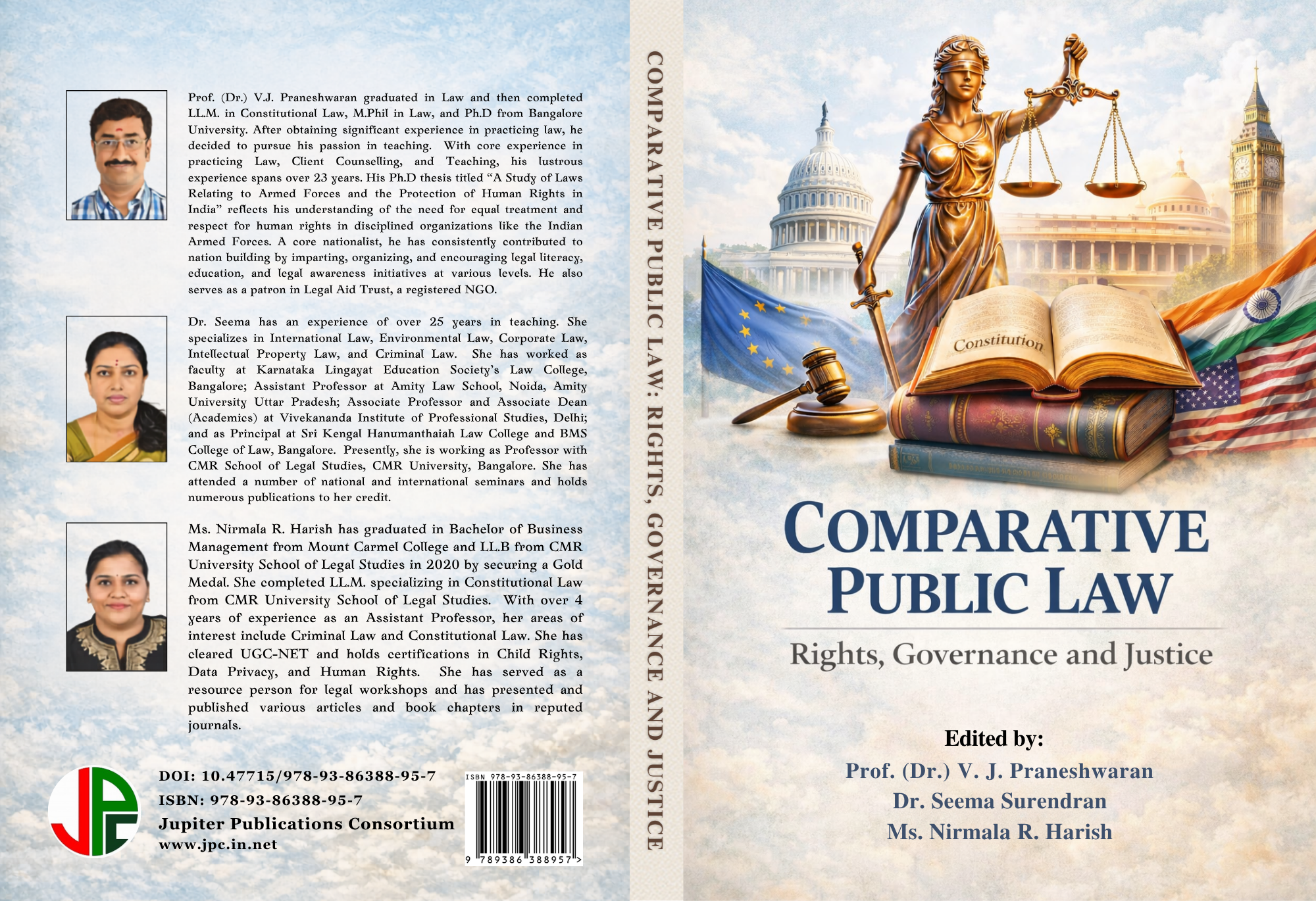
Comparative Public Law: Rights, Governance and Justice
A vibrant and authoritative edited collection exploring constitutional design,
rights protection, democratic governance, public institutions, criminal justice,
accountability, and comparative constitutional thought.
Prof. (Dr.) V.J. Praneshwaran
Dr. Seema Surendran
Ms. Nirmala R. Harish
Research Chapters
Jurisdictions
Major Themes
Published Edition
About the Volume
A colorful intellectual journey through rights, governance, and justice
Comparative Public Law: Rights, Governance and Justice is a refined edited academic collection devoted to the comparative study of public law across constitutional systems. It brings together thirty-one scholarly contributions on rights, governance, institutional design, accountability, justice, and public power. The volume examines how constitutional democracies address recurring legal questions:
how power should be distributed, how rights should be protected, how courts should review state action, how criminal justice should protect both victims and accused persons, and how accountability institutions can preserve public trust. With comparative engagement across India, the United States, the United Kingdom, Canada, Brazil, Germany, France, Norway, Denmark, and South Korea, this book offers a strong academic resource for legal scholarship, postgraduate study, classroom discussion, and public law research.
Why This Book Stands Out
A dynamic, comparative, and research-rich academic contribution
The book is designed to be more than a collection of chapters. It is a structured
comparative conversation on constitutional systems, public institutions, rights,
criminal justice, and democratic accountability.
Comparative Depth
Places multiple jurisdictions in conversation to reveal shared constitutional concerns and distinct institutional responses.
Current Public Law Issues
Addresses emergency powers, federalism, judicial review, hate speech, sedition, corruption, domestic violence, and economic offences.
Research Utility
Useful for LL.M. students, Ph.D. scholars, law teachers, researchers, practitioners, and institutional libraries.
Global Comparative Reach
Jurisdictions Featured in the Volume
The collection brings together constitutional and public law perspectives from
multiple democratic and institutional traditions.
United States
United Kingdom
Canada
Brazil
Germany
France
Norway
Denmark
South Korea
Six powerful streams of public law scholarship
Constitutional Structure
Emergency powers, constitutional asymmetry, federalism, sovereignty, unitary and federal government, and parliamentary and presidential systems.
Rights and Liberties
Fundamental rights, freedom of expression, hate speech, sedition, domestic violence, individual liberty, and constitutional limits on state power.
Judicial Power
Judicial interpretation, judicial review, due process, constitutionalism, basic structure doctrine, and the role of courts in public law.
Criminal Justice
Victims’ rights, rights of accused persons, presumption of innocence, juvenile bail, plea bargaining, human rights, and procedural fairness.
Accountability Institutions
Lokayukta, ombudsman institutions, whistleblower protection, administrative checks, anti-corruption law, and public integrity.
Economic and Regulatory Justice
Corporate criminal liability, economic offences, delegated legislation, welfare administration, financial misconduct, and regulatory governance.
Reading Pathways
Read it chapter-wise, theme-wise, or research-wise
Readers interested in constitutional structure may begin with emergency powers, federalism, asymmetry, sovereignty, separation of powers, judicial review, and delegated legislation.
Readers focused on rights and justice may turn to chapters on victims and accused persons, human rights of accused persons, domestic violence, juvenile bail, freedom of expression, hate speech, sedition, and fundamental rights.
Researchers working on accountability and integrity may focus on Lokayukta, ombudsman institutions, whistleblower protection, administrative checks, anti-corruption law, corporate liability, and economic offences.
Editorial Leadership
Edited by experienced legal academics
The volume reflects the academic guidance of editors associated with CMR School
of Legal Studies, CMR University.
Prof. (Dr.) V.J. Praneshwaran
Director, School of Legal Studies, CMR University
Prof. (Dr.) V.J. Praneshwaran holds LL.M. in Constitutional Law, M.Phil. in Law, and Ph.D. from Bangalore University. With over 23 years of distinguished experience in legal practice, client counselling, teaching, legal literacy, and academic leadership, he brings strong constitutional and human rights expertise to the volume.
Dr. Seema Surendran
Professor, School of Legal Studies, CMR University
Dr. Seema Surendran has over 25 years of teaching experience. Her areas of specialisation include International Law, Environmental Law, Corporate Law, Intellectual Property Law, and Criminal Law. She has held senior academic roles and contributed widely to legal scholarship.
Ms. Nirmala R. Harish
Assistant Professor, CMR School of Legal Studies
Ms. Nirmala R. Harish holds LL.B. and LL.M. specialising in Constitutional Law from CMR University School of Legal Studies. A Gold Medal recipient and UGC-NET qualified academic, her areas of interest include Criminal Law and Constitutional Law.
Complete Chapter Catalogue
Thirty-one scholarly contributions in one authoritative collection
Each chapter is a focused comparative study addressing rights, governance,
institutions, accountability, constitutional doctrine, criminal justice, and public law.
National Emergency Implementation and Its Effects: A Study of United States of America and India
Starts at page 1
A comparative study of emergency powers, constitutional safeguards, executive authority, national security, and civil liberty.
Constitutional Amendments Affecting Asymmetry: A Critical Study
Starts at page 10
Explores constitutional amendments, asymmetrical federalism, regional identity, autonomy, and national integration.
Position of Victims and Accused in the Criminal Justice Systems of the USA and UK: A Comparative Study
Starts at page 17
Compares victim rights, accused protections, due process, fair trial guarantees, and criminal justice reforms.
Lokayukta as the State Ombudsman in India: A Study with Special Reference to Karnataka and Kerala
Starts at page 24
Analyses Lokayukta institutions, corruption control, maladministration, public accountability, and state-level governance.
Unitary Form of Government: A Comparative Analysis of India and Brazil
Starts at page 36
Studies unitary and federal governance features through a comparative analysis of India and Brazil.
A Comparative Analysis of Judicial Interpretation in Adversarial and Inquisitorial Systems
Starts at page 44
Examines judicial interpretation, court reasoning, legal procedure, and adjudicatory models.
Separation of Powers in India: A Comparative Constitutional Study
Starts at page 53
Investigates the separation of powers as a constitutional safeguard against concentration of authority.
Whistleblower Protection Laws: A Comparative Analysis of India and the United States
Starts at page 64
Highlights whistleblower protection, public interest disclosure, institutional accountability, and anti-corruption governance.
Federalism and Sovereignty: A Comparative Study of India and U S
Starts at page 72
Explores federal power distribution, sovereignty, constitutional authority, and centre-state relations.
Human Rights Approach to Accused of Crime: A Comparative Study
Starts at page 79
Frames accused persons’ rights within human rights principles, constitutional democracy, and criminal process.
Judicial Review as Constitutionalism’s Guardian: India’s Basic Structure Doctrine vs. UK’s Parliamentary Sovereignty Limits
Starts at page 88
Compares judicial review, constitutionalism, basic structure doctrine, and parliamentary sovereignty.
The Ombudsman Institution: A Comparative Study of Norway and Denmark
Starts at page 101
Studies ombudsman institutions as tools of administrative accountability, citizen protection, and good governance.
A Comparative Study of Fundamental Rights in India and the UK
Starts at page 113
Compares constitutional protection of fundamental rights in India and the United Kingdom.
Separation of Powers and Economic Governance: A Comparative Study of India and the United Kingdom
Starts at page 120
Studies the connection between institutional structure, constitutional power, and economic governance.
State Responsibility and Domestic Violence: A Comparative Study of India and UK
Starts at page 131
Examines domestic violence as a public law, human rights, and state responsibility concern.
Freedom of Expression in Constitutional Democracies: A Comparative Study of India and the United Kingdom
Starts at page 141
Analyses free expression, democratic liberty, constitutional restrictions, and comparative speech protections.
Checks and Balances on the Administrative Mechanisms in India and the United States: An Analysis
Starts at page 147
Explores administrative checks, oversight, accountability, and institutional restraint in India and the United States.
Corporate Criminal Liability: A Comparative Study of India and Germany
Starts at page 159
Compares corporate accountability, financial misconduct, criminal responsibility, and regulatory enforcement.
Parliamentary and Presidential Forms of Government: A Comparative Analysis of India and the United States
Starts at page 168
Contrasts parliamentary and presidential systems through executive accountability and constitutional design.
Juvenile Bail in India and the United Kingdom: A Comparative Public Law Analysis
Starts at page 176
Studies juvenile bail through personal liberty, rehabilitation, child justice, and protective criminal jurisprudence.
Federalism: A Comparative Study Between India and Canada
Starts at page 185
Compares federal power-sharing, constitutional structure, and centre-regional governance in India and Canada.
Judicial Review and Due Process Comparative Study of India and USA
Starts at page 198
Examines judicial review and due process as safeguards against arbitrary exercise of state power.
Corruption and Legal Challenges: Lokayukta as the State Ombudsman in Rajasthan
Starts at page 208
Studies corruption control and the role of the Lokayukta in Rajasthan’s accountability framework.
Plea Bargaining and Its Effect: A Study of India and the USA
Starts at page 219
Compares plea bargaining as a tool of negotiated justice, criminal process efficiency, and case resolution.
Delegated Legislation as a Tool of Welfare Administration: A Comparative Study of France and India
Starts at page 230
Explores delegated legislation in welfare administration, public governance, and regulatory decision-making.
Criminalisation of Economic Offences: A Comparative Public Law Analysis of India and the United States
Starts at page 238
Studies economic offences, financial misconduct, market regulation, technological change, and public law enforcement.
Plea Bargaining as a Part of Criminal Law System: A Comparative Study of India and UK
Starts at page 250
Compares plea bargaining in India and the UK as a response to trial delays and criminal case backlog.
Freedom of Speech and Hate Speech in India and the USA: A Comparative Analysis
Starts at page 260
Compares expressive liberty, constitutional free speech protection, and hate speech regulation.
Nobody is Guilty Until Proven. Position of Accused in Criminal Justice System in India: A Legal Study
Starts at page 268
Studies the presumption of innocence and the legal position of accused persons in Indian criminal justice.
Corruption as a White-Collar Crime: A Comparative Study of Anti-Corruption Laws in India and South Korea
Starts at page 278
Compares anti-corruption law, white-collar crime, public integrity, and governance reform.
Sedition and Criminal Justice: A Comparative Study of India and United Kingdom
Starts at page 287
Examines sedition, state security, dissent, freedom of expression, and criminal justice.
Key Legal Concepts
A rich glossary of constitutional and public law ideas
The volume engages with key legal ideas used in comparative constitutional law,
administrative law, criminal justice, governance, and accountability studies.
Constitutionalism
Rule of Law
Federalism
Asymmetrical Federalism
Basic Structure Doctrine
Judicial Review
Due Process
Separation of Powers
Checks and Balances
Fundamental Rights
Emergency Powers
Ombudsman
Lokayukta
Whistleblower
Public Integrity
Corporate Criminal Liability
Plea Bargaining
Presumption of Innocence
Domestic Violence
Hate Speech
Sedition
Ideal For
A valuable reference for academic and professional readers
Bring This Volume Into Your Academic Library
Acquire a colorful, rigorous, and contemporary collection on rights,
governance, institutions, and justice.
This edited volume is a strong addition for university libraries, postgraduate
classrooms, legal research centres, public law scholars, and readers interested
in comparative constitutional governance.


Reviews
There are no reviews yet.