

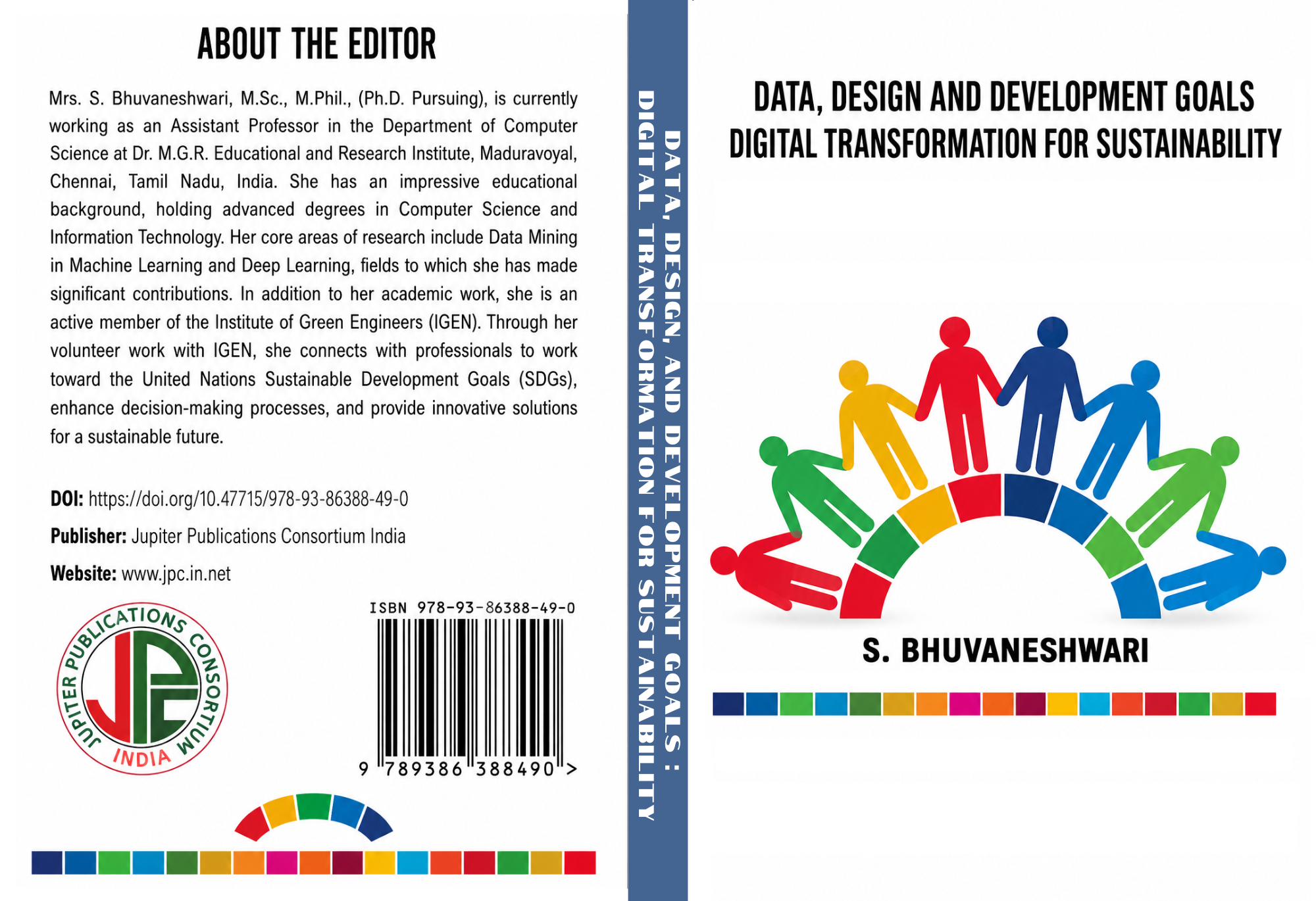
Data, Design, and Development Goals
Digital Transformation for Sustainability is an interdisciplinary edited academic volume that examines how data-driven systems, digital innovation, artificial intelligence, design thinking, smart technologies, and sustainable governance can support the achievement of the Sustainable Development Goals.
Edited by Mrs. S. Bhuvaneshwari, this volume brings together scholarly chapters on poverty reduction, food security, health and well-being, quality education, gender equality, clean water, renewable energy, economic growth, smart cities, circular economy, climate action, urban digital twins, terrestrial ecosystems, intelligent governance, global partnerships, and India’s SDG progress.
Product Description
Data, Design, and Development Goals: Digital Transformation for Sustainability explores the relationship between emerging digital technologies and sustainable development. It presents SDG-focused academic chapters that connect data analytics, artificial intelligence, smart systems, digital governance, sustainable design, and development policy.
The book highlights how digital transformation can move beyond technical modernization and become a catalyst for inclusive growth, efficient institutions, smart infrastructure, climate responsiveness, responsible consumption, environmental sustainability, and social equity. It is designed for students, researchers, educators, policymakers, sustainability professionals, and technology practitioners.
Book Details
Data, Design, and Development Goals
Digital Transformation for Sustainability
Mrs. S. Bhuvaneshwari
Jupiter Publications Consortium India
First Edition
15th June 2026
978-93-86388-49-0
Rs.400/-
282
Digital Transformation, Sustainability, Sustainable Development Goals
director@jpc.in.net
About the Volume
This edited academic volume brings together interdisciplinary perspectives on the relationship between data-driven systems, digital innovation, design thinking, and the Sustainable Development Goals. The book examines how digital transformation can contribute to inclusive growth, resilient institutions, smart infrastructure, sustainable cities, health, education, climate action, responsible consumption, and global partnerships.
The chapters are arranged around SDG-focused themes and demonstrate how emerging technologies, analytics, artificial intelligence, digital governance, smart systems, and sustainable design approaches can be applied to contemporary developmental challenges.
Core Themes
Key Features
- Interdisciplinary academic treatment of digital transformation and sustainability.
- SDG-focused chapters covering social, economic, environmental, institutional, and technological dimensions.
- Coverage of artificial intelligence, data analytics, digital governance, smart systems, renewable energy, and urban digital twins.
- Useful for students, faculty members, researchers, policymakers, and development professionals.
- Includes chapter-wise discussions on poverty, hunger, health, education, gender equality, climate action, governance, and partnerships.
- Connects sustainable development challenges with digital innovation and design-based solutions.
- Suitable for courses in sustainability, digital transformation, data science, public policy, computer science, and development studies.
- Includes contributors list, glossary, abbreviations, editor profile, and structured chapter organization.
Who Should Read This Book?
- Undergraduate and postgraduate students
- Research scholars
- Faculty members and academic professionals
- Computer science and data science learners
- Management and public policy students
- Sustainability researchers
- Technology and innovation professionals
- Policy planners and development practitioners
- Smart city and digital governance professionals
- Readers interested in SDGs and sustainable digital transformation
About the Editor
Mrs. S. Bhuvaneshwari
Mrs. S. Bhuvaneshwari, M.Sc., M.Phil., (Ph.D. Pursuing), is currently working as an Assistant Professor in the Department of Computer Science at Dr. M.G.R. Educational and Research Institute, Maduravoyal, Chennai, Tamil Nadu, India.
Her research areas include Data Mining in Machine Learning and Deep Learning. She is also an active member of the Institute of Green Engineers (IGEN), where she works toward the United Nations Sustainable Development Goals, improved decision-making, and sustainable innovation.
Editorial Focus
The editor has brought together academic contributions that connect technology, sustainability, data, design, governance, and development goals. The volume reflects an interdisciplinary vision for applying digital transformation to real-world sustainability challenges.
Contributors
Table of Contents
Chapter 1: GOAL 1 – No Poverty by 2030: Building a Better Future for All
Author: Dr. Ramani R.
Page: 1
Chapter 2: GOAL 2 – The Cost of Nourishment: Analysing the Impact of Food Price Inflation and Supply Chain Friction on Achieving SDG 2
Author: M. Sindhuja
Page: 15
Chapter 3: GOAL 3 – Good Health and Well-Being: Ensuring Healthy Lives and Promoting Well-Being for All
Author: Ms. K. Suganya
Page: 26
Chapter 4: GOAL 4 – The Comprehensive Architecture of SDG 4
Author: S. S. Aljaswana
Page: 40
Chapter 5: GOAL 5 – Advancing Gender Equality and Women’s Empowerment
Author: Dr. G. Nandhini
Page: 57
Chapter 6: GOAL 6 – AI-Driven Smart Water Management for Sustainable Cities
Authors: S. Tamil Selvi and Dr. D. Usha
Page: 75
Chapter 7: GOAL 7 – Hybrid LSTM-XGBoost Model for Renewable Energy Forecasting
Authors: L. Rajalakshmi and Dr. Vaidehi
Page: 86
Chapter 8: GOAL 8 – Hybrid ARIMA-LSTM Model for Stock Price Prediction
Authors: S. Bhuvaneshwari and Dr. S. Nirmala Sugirtha Rajini
Page: 101
Chapter 9: GOAL 9 – Vision Image Processing
Authors: S. Sangeetha and Dr. S. Nirmala Sugirtha Rajini
Page: 112
Chapter 10: GOAL 10 – Impact of Digital Transformation toward Sustainable Development
Authors: A. Florence and R. Meera
Page: 123
Chapter 11: GOAL 11 – Strategic Frameworks for Sustainable Cities and Communities
Authors: Ms. Selvarani and Mrs. K. Anitha
Page: 137
Chapter 12: GOAL 12 – Circular Economy, Sustainable Living, and Digital Transformation
Author: Dr. R. Usha Nandhini
Page: 149
Chapter 13: GOAL 13 – Climate Change Mitigation and Global Sustainability
Author: Dr. G. Grace Jebakani Sweety
Page: 172
Chapter 14: GOAL 14 – Urban Digital Twins Integration in Smart City Development
Author: Mr. U. Mohan
Page: 187
Chapter 15: GOAL 15 – Life on Land: Beyond Conservation and Terrestrial Ecosystems
Authors: S. Bakyalakshmi and D. Vijayalakshmi
Page: 205
Chapter 16: GOAL 16 – Artificial Intelligence, Justice, Peace, and Robust Institutions
Authors: M. Suwithra and Dr. A. R. Arunachalam
Page: 227
Chapter 17: GOAL 17 – Beyond Insolvency and the G20 Common Framework
Author: Mr. Adit
Page: 240
Chapter 18: GOAL 18 – The Indian Context of Sustainable Development
Author: Dr. P. Subburethina Bharathi
Page: 248
Chapter-wise Abstracts and Keywords
Chapter 1 – No Poverty by 2030
Author: Dr. Ramani R.
Abstract: This chapter discusses SDG 1 and the mission to end poverty in all its forms by 2030. It explains the causes and effects of poverty, including unemployment, lack of education, inequality, poor healthcare, climate change, and political instability.
Keywords: No Poverty, SDG 1, Social Protection, Education, Employment, Financial Inclusion, Poverty Reduction.
Chapter 2 – Food Price Inflation and Supply Chain Friction
Author: Mrs. M. Sindhuja
Abstract: This chapter examines how food price inflation and supply chain disruption affect the achievement of SDG 2. It focuses on food security, global food commodity prices, hunger, nutrition, and the need for resilient food systems.
Keywords: Zero Hunger, SDG 2, Food Price Inflation, Supply Chain Friction, Food Security, Nutrition.
Chapter 3 – Good Health and Well-Being
Author: Ms. K. Suganya
Abstract: This chapter focuses on SDG 3 and discusses public health, disease prevention, mental health, healthcare access, universal health coverage, digital health, and resilient healthcare systems.
Keywords: Health, Well-Being, Healthcare, Public Health, Mental Health, Disease Prevention, Universal Health Coverage.
Chapter 4 – Quality Education and Global Educational Disparities
Author: S. S. Aljaswana
Abstract: This chapter analyzes educational disparities, institutional barriers, financial bottlenecks, marginalized learners, and multi-sectoral strategies required to achieve inclusive and equitable quality education under SDG 4.
Keywords: SDG 4, Quality Education, Educational Disparities, Human Capital, Inclusive Education.
Chapter 5 – Gender Equality and Women’s Empowerment
Author: Dr. G. Nandhini
Abstract: This chapter examines gender equality as a foundation for sustainable development, social justice, economic progress, education, healthcare, political participation, and women’s empowerment.
Keywords: Gender Equality, Women Empowerment, Gender-Based Violence, Economic Empowerment, SDG 5.
Chapter 6 – AI-Driven Smart Water Management
Authors: S. Tamil Selvi and Dr. D. Usha
Abstract: This chapter explores artificial intelligence, Internet of Things, and deep learning for water demand forecasting, leakage detection, and efficient smart water management.
Keywords: SDG 6, Smart Water Management, Artificial Intelligence, Deep Learning, LSTM, Leakage Detection, IoT.
Chapter 7 – Renewable Energy Forecasting
Authors: L. Rajalakshmi and Dr. Vaidehi
Abstract: This chapter studies renewable energy forecasting through a hybrid LSTM-XGBoost model and connects clean energy forecasting, smart grids, and sustainable development with SDG 7.
Keywords: Renewable Energy, SDG 7, LSTM, XGBoost, Smart Grid, Energy Forecasting, Deep Learning.
Chapter 8 – Stock Price Prediction and Financial Stability
Authors: S. Bhuvaneshwari and Dr. S. Nirmala Sugirtha Rajini
Abstract: This chapter examines stock price prediction using a hybrid ARIMA-LSTM model and connects financial forecasting with economic stability and SDG 8.
Keywords: Stock Price Prediction, Hybrid ARIMA-LSTM, Hyperparameter Optimization, Financial Stability, SDG 8.
Chapter 9 – Vision Image Processing
Authors: S. Sangeetha and Dr. S. Nirmala Sugirtha Rajini
Abstract: This chapter discusses vision image processing, machine learning, smart devices, IoT, visual data analysis, and digital transformation in modern technological systems.
Keywords: Vision Image Processing, Machine Learning, IoT, Image Analysis, Smart Devices, Digital Transformation.
Chapter 10 – Digital Transformation and Sustainable Development
Authors: A. Florence and R. Meera
Abstract: This chapter studies how digital transformation supports sustainability, efficiency, stakeholder engagement, governance, competitiveness, and long-term organizational development.
Keywords: Digital Transformation, Sustainable Development, Digital Technology, Stakeholders, Economy, Governance.
Chapter 11 – Sustainable Cities and Communities
Authors: Ms. Selvarani and Mrs. K. Anitha
Abstract: This chapter explores strategic frameworks for sustainable cities, smart infrastructure, urban planning, ecological responsibility, social inclusion, and community resilience.
Keywords: Sustainable Cities, SDG 11, Smart Infrastructure, Urban Planning, Community Resilience.
Chapter 12 – Circular Economy and Sustainable Living
Author: Dr. R. Usha Nandhini
Abstract: This chapter examines circular economy principles, sustainable living, responsible consumption, production, AI-enabled sustainability, waste management, and SDG 12 implementation in India.
Keywords: Circular Economy, Sustainable Living, SDG 12, Responsible Consumption, Digital Transformation, Waste Management.
Chapter 13 – Climate Change Mitigation
Author: Dr. G. Grace Jebakani Sweety
Abstract: This chapter examines climate change, global warming, greenhouse gases, mitigation, adaptation, awareness, renewable energy, and environmental protection under SDG 13.
Keywords: Climate Action, Global Warming, Greenhouse Gases, Sustainability, Paris Agreement, Renewable Energy, SDG 13.
Chapter 14 – Urban Digital Twins
Author: Mr. U. Mohan
Abstract: This chapter explores Urban Digital Twins and their role in smart city development, sustainability, urban planning, artificial intelligence, data integration, and edge computing.
Keywords: Urban Digital Twins, Artificial Intelligence, Smart Cities, Sustainable Urban Planning, Data Integration, Edge Computing.
Chapter 15 – Life on Land
Authors: S. Bakyalakshmi and D. Vijayalakshmi
Abstract: This chapter focuses on terrestrial ecosystems, biodiversity, land degradation, desertification, ecosystem services, conservation, environmental policy, and SDG 15.
Keywords: SDG 15, Terrestrial Ecosystems, Land Degradation, Desertification, Biodiversity, Environmental Policy.
Chapter 16 – AI, Justice, Peace, and Institutions
Authors: M. Suwithra and Dr. A. R. Arunachalam
Abstract: This chapter examines the role of AI in strengthening peace, justice, governance, institutional transparency, accountability, digital governance, blockchain, and citizen participation.
Keywords: AI, SDG 16, Governance, Peace, Justice, Strong Institutions, Blockchain, Transparency, Accountability.
Chapter 17 – G20 Common Framework and SDG 17
Author: Mr. Adit
Abstract: This chapter critically examines the G20 Common Framework for Debt Treatment, sovereign debt distress, debt restructuring, international cooperation, private sector holdouts, and debt sustainability.
Keywords: G20 Common Framework, SDG 17, Sovereign Debt Distress, Debt Sustainability, Geopolitical Friction.
Chapter 18 – The Indian Context of Sustainable Development
Author: Dr. P. Subburethina Bharathi
Abstract: This chapter examines India’s approach to SDG implementation through NITI Aayog, MoSPI, the National Indicator Framework, SDG India Index, Aspirational Districts Programme, clean energy, digital infrastructure, and localized governance.
Keywords: Sustainable Development Goals, SDG India Index, NITI Aayog, Localization, Indian Development, SDG Monitoring.
Glossary Highlights
Abbreviations Used
Artificial Intelligence
AutoRegressive Integrated Moving Average
Digital Transformation
Internet of Things
Long Short-Term Memory
Sustainable Development Goal
United Nations
Extreme Gradient Boosting
How to Use This Book
Readers may approach this volume chapter by chapter to understand the wider relationship between digital transformation and the Sustainable Development Goals. They may also select individual SDG chapters based on academic, research, teaching, or professional interest.
Instructors may use this book as discussion material for courses in sustainability, digital transformation, data science, computer science, public policy, management, governance, and interdisciplinary development studies.
Citation Format
Bhuvaneshwari, S. (Ed.). (2026). Data, Design, and Development Goals: Digital Transformation for Sustainability. Jupiter Publications Consortium India. ISBN: 978-93-86388-49-0. DOI: 10.47715/978-93-86388-49-0
Copyright and Disclaimer
Copyright in each chapter remains with the respective author(s), unless otherwise assigned by written agreement. Copyright in the editorial arrangement, front matter, and compilation belongs to the editor and publisher as applicable. No part of this publication may be reproduced, stored in a retrieval system, or transmitted in any form or by any means without prior written permission from the publisher and/or the concerned rights holder.
The views expressed in the chapters are those of the contributing authors. The editor and publisher are not responsible for any errors, omissions, interpretations, or consequences arising from the use of information contained in this volume.
Publisher Information
Jupiter Publications Consortium India
22/102 Second St., Venkatesa Nagar, Virugambakkam,
Chennai – 600092, Tamil Nadu, India
Phone: +91 9790911374, 9962578190
Email: director@jpc.in.net
Website: www.jpc.in.net


Reviews
There are no reviews yet.